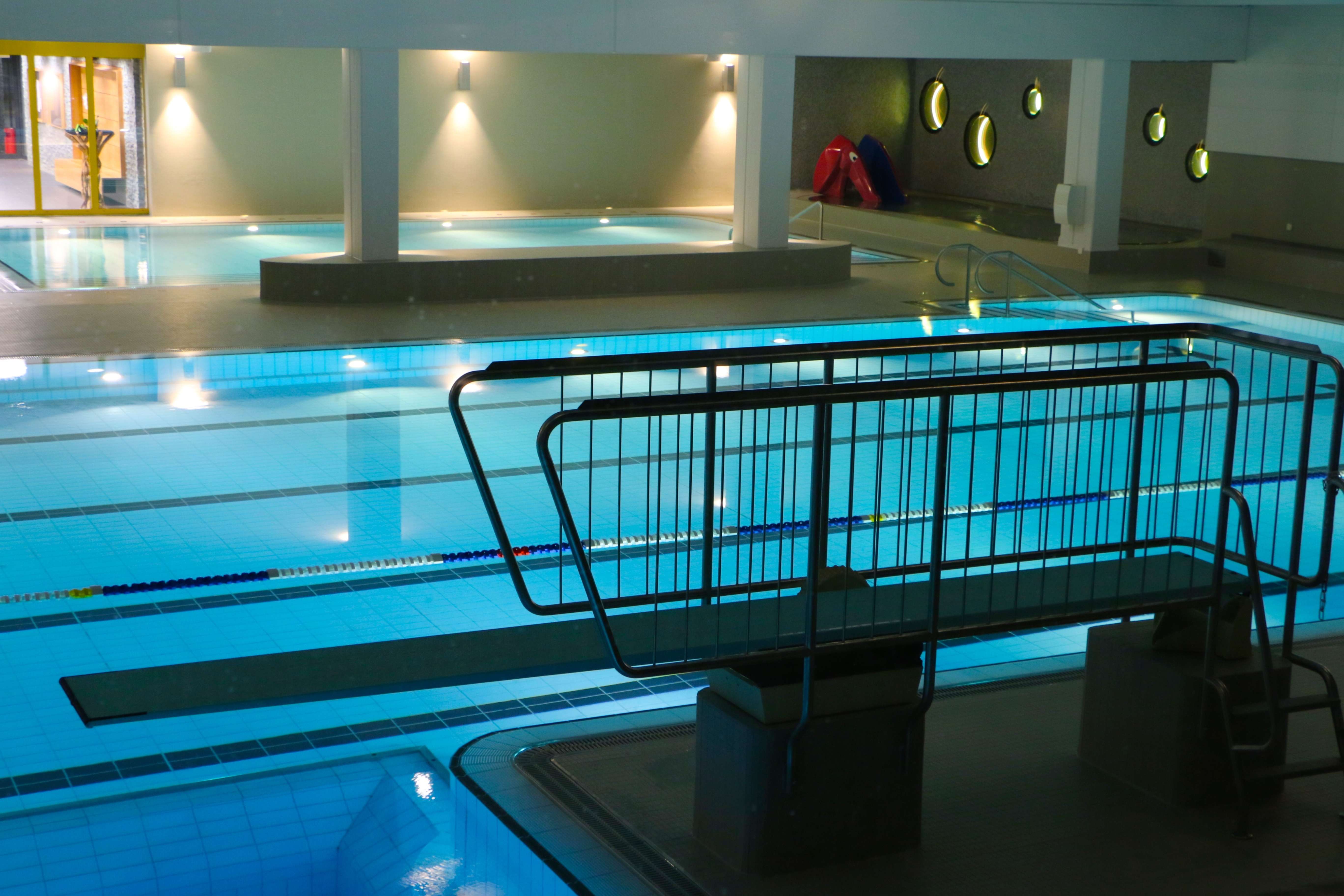
A commercial pool boiler is sized for heat-up; a heat pump can be sized for maintenance, roughly one fifth of the heat-up load in the worked case. The pool's own water mass carries the hours the heat pump is off, while a storage tank carries the locker-room shower peak. The smaller machine cannot refill a drained pool from cold in a useful time: retain a heat-up source or accept a long refill schedule.
Key Takeaways
A pool boiler is sized for the week the pool is refilled from cold. DOE's Energy Saver sizing rule, surface area multiplied by temperature rise multiplied by 12, is a heat-up rule based on a water temperature rise of 1 to 1.25 F per hour. Applied to a 25-yard, 6-lane pool, it returns about 1,134,000 Btu/hr. The load that keeps the same pool at 80 F is on the order of 213,000 Btu/hr, so the boiler runs near 20 percent of nameplate for 51 weeks of the year.
That gap is the design opportunity when the boiler is replaced. An air-to-water heat pump sized to the maintenance load, with the dehumidifier returning the latent heat it removes and the pool's water mass carrying the off hours, is a much smaller machine. Storage handles the load with no thermal mass of its own: the locker-room shower peak after a meet or school session. The calculations below use a stated pool in US units and identify what the smaller machine cannot do on a cold-start refill.
In this article
Where the energy in an aquatic center goes
Pool water heating dominates the energy bill of an aquatic facility. The New South Wales Office of Environment and Heritage's technology guide for aquatic centres, an Australian government document whose percentages are climate-dependent and characterized here rather than applied as US statistics, attributes 60 to 80 percent of centre energy to pool heating and 5 to 15 percent to domestic hot water. It puts evaporation at roughly 65 percent of pool heat loss and states that electric heat pumps are typically the most efficient heating system.
The US benchmark is ENERGY STAR. EPA's Portfolio Manager technical reference for swimming pools models an indoor pool at 80 F water, 75 F air, 65 percent relative humidity, still air, and 8,760 hours. It assigns a US school with a short-course indoor pool—25 yards by 20 yards, or 4,500 square feet—2,084,866 kBtu per year of source energy, counting evaporation and convection and excluding shell conduction and make-up water. That averages about 238 kBtu/hr including pumping: the order of a maintenance load, not a heat-up load.
DOE's pool cover guidance states that evaporation is by far the largest source of pool energy loss, that indoor pools require ventilation to control the humidity it creates, and that covering a pool when not in use can cut heating costs by 50 to 70 percent. Every term in the calculation below runs through the evaporation rate, and so does the dehumidifier.
Thermal energy storage for schools and universities covers campus-wide strategy; this article works the natatorium case.
The pool is a thermal store, the showers are not
The pool water is a large thermal mass with a slow, continuous loss; the showers are a small volume with a sharp, short demand. The first stores its own energy; the second needs a tank.
DOE puts the COP of heat pump pool heaters at 3.0 to 7.0 and notes that efficiency falls once outdoor air drops below the 45 to 50 F range. That range spans warm-climate pool units; a cold-climate air-to-water unit serving 140 F storage can operate at the low end or below it. Winter operation in a northern climate requires a cold-climate unit or a retained boiler share.
The pool side is a low-temperature load, about 80 F, where a heat pump runs at its best COP. The shower side at 140 F storage requires a higher lift and has a lower COP.
A natatorium dehumidifier is itself a heat pump. Its evaporator condenses moisture out of the pool hall air. The latent heat of that moisture plus compressor work is rejected at the condenser into supply air, a pool water condenser, or outdoors, according to the design.
At the Forest Hills Public Schools Community and Aquatic Center in Michigan, ACHR News reports that retrofit dehumidifiers use compressor waste heat to heat the 80 F pool water, with a 995 MBH boiler-fed heat exchanger available for extreme cold. Recovered heat first, boiler held in reserve, is the pattern sized here.
Size the heat pump to the maintenance load plus the daily shower energy. Let the pool's mass carry the off hours. Put energy-storage capacity on the shower side only; a pool-side tank serves a buffer role. Retain a heat-up source, or write a refill schedule the owner accepts.
Three heat flows in a natatorium and what each is sized by
Working the pool heat loss for a 25-yard, 6-lane pool
Every figure below is a labeled assumption to be replaced with the facility's own values.
A = length × width = 75 ft (25 yd) × 42 ft (6 lanes × assumed 7 ft lane width) = 3,150 sq ft
V = A × average depth × 7.48 gal/cu ft = 3,150 sq ft × 6 ft assumed average depth (ENERGY STAR assumption) × 7.48 gal/cu ft = 141,400 gal
m = V × 8.34 lb/gal = 141,400 gal × 8.34 lb/gal = 1,179,000 lb
Water temperature is taken at 80 F from ENERGY STAR and the Forest Hills case. Competition, instruction, and therapy temperatures differ; the facility's operating record governs.
Heat-up load by the DOE rule. DOE's formula subtracts the coldest-month average air temperature from the target pool temperature. For an indoor refill, the equivalent term is the fill water temperature, assumed here to be 50 F.
Q_heatup = A × ΔT_rise × 12 Btu/hr per sq ft-F
Q_heatup = 3,150 sq ft × (80 F − 50 F) × 12 Btu/hr per sq ft-F
= 1,134,000 Btu/hr
= 1,134 MBH = 332 kW thermal
The 12 is not arbitrary. Dividing 1,134,000 Btu/hr by the 1,179,000 lb of pool water gives 0.96 F per hour, DOE's stated basis for a 6-foot-deep pool. A 30 F rise at that rate takes about 31 hours before losses. This sizes a heat-up rate, not the load required to maintain temperature.
Maintenance load from evaporation. The evaporation rate is the governing assumption. The ASHRAE Handbook evaporation equation at 80 F water, 75 F air, 65 percent RH, and a public-pool activity factor returns rates near 0.04 lb per hour per square foot. The calculation uses 0.042 lb/hr-sq ft as an assumption for the reader's engineer to recalculate.
The 1998 ASHRAE Transactions study by Colorado State University's Solar Energy Applications Laboratory with DOE, archived by OSTI, measured undisturbed pools at 74 percent of the equation, found rates rising 40 to 70 percent as swimmer count grew, and averaged 26 percent above the equation at 15 to 20 swimmers per 1,000 square feet. The assumption sits between the measured quiet and measured busy pool.
Assumed evaporation rate = 0.042 lb/hr-sq ft
Assumed latent heat, h_fg = 1,050 Btu/lb
Assumed evaporation share of total heat loss = 65 percent
w_evap = A × rate = 3,150 sq ft × 0.042 lb/hr-sq ft = 132 lb/hr
Q_evap = w_evap × h_fg = 132 lb/hr × 1,050 Btu/lb
= 138,600 Btu/hr
Q_maint = Q_evap / evaporation share = 138,600 Btu/hr / 0.65
= 213,200 Btu/hr
= 213 MBH = 62.4 kW thermal
= 1,500 kWh thermal per day
The heat-up-to-maintenance ratio is 1,134 MBH to 213 MBH, or 5.3 to 1: the margin the boiler was carrying. The assumed 65 percent evaporation share folds conduction and make-up water into the remainder, which ENERGY STAR excludes. The estimate therefore sits deliberately above the ENERGY STAR benchmark per square foot.
The pool as storage. One degree of pool temperature is a large quantity of heat.
Q_pool = m × c × ΔT = 1,179,000 lb × 1 Btu/lb-F × 1 F
= 1,179,000 Btu
= 346 kWh thermal per degree F
t = Q_pool / Q_maint = 346 kWh thermal / 62.4 kW thermal
= 5.5 hours of maintenance load carried by a 1 F band
A heat pump can be scheduled off the pool for a five-hour on-peak window and the water drops about 1 F, with no tank involved. The tank's role on the pool side is the one described in heat pump buffer tank sizing for commercial systems: minimum loop volume, hydraulic separation, and defrost ride-through, not stored kWh for load shifting. The chilled water buffer tank sizing method, which states that a buffer does not shift load, applies by analogy.
What the dehumidifier gives back
Recoverable heat is bounded by physics: the latent heat of the moisture condensed plus the compressor's electrical input is the maximum rejected at the condenser. It exists only while the dehumidifier runs. The control sequence splits it between air reheat and the pool water condenser.
Q_latent = w_evap × h_fg = 132 lb/hr × 1,050 Btu/lb
= 138,600 Btu/hr = 40.6 kW thermal
W_comp = 15 kW electrical (assumed compressor input) = 51,200 Btu/hr
Q_reject = Q_latent + W_comp = 138,600 Btu/hr + 51,200 Btu/hr
= 189,800 Btu/hr = 55.6 kW thermal
Assumed share to pool water condenser = 50 percent; remainder goes to supply air reheat
Q_to_pool = 0.50 × 55.6 kW thermal = 27.8 kW thermal = 94,900 Btu/hr
Share of maintenance load covered while running = Q_to_pool / Q_maint
= 27.8 kW thermal / 62.4 kW thermal = 45 percent
At an assumed 14 hours per day of full-rate recovery, the pool receives about 389 kWh thermal per day from the dehumidifier, leaving roughly 1,110 kWh thermal per day for the heat pump. Recovery is indoor-sourced and does not fall off with outdoor temperature, making it the first resource in a northern climate.
Recovery shrinks when a pool cover is deployed. Less evaporation means less latent heat to recover and less load to cover, so the cover reduces heat pump duty and dehumidifier credit together.
Heat recovery chillers vs thermal energy storage sets out the rule that recovered heat is only worth its coincidence with the load. In a natatorium, the coincidence is unusually good: evaporation is the loss, and the dehumidifier is recovering it.
Sizing the shower peak and the storage that carries it
The locker-room shower method is worked in full in thermal energy storage for fitness clubs and gyms, including flow rate, duration, and the 140 F storage to 110 F floor convention. It is applied here.
Assumed daily showers = 300
Assumed volume per shower = 5 min × 2.0 gpm = 10 gal at 105 F mixed
Assumed inlet temperature = 55 F
Daily volume = showers/day × gal/shower = 300 × 10 gal = 3,000 gal/day
ΔT = mixed temperature − inlet temperature = 105 F − 55 F = 50 F
Q_day = daily volume × 8.34 lb/gal × c × ΔT
= 3,000 gal × 8.34 lb/gal × 1 Btu/lb-F × 50 F
= 1,251,000 Btu = 367 kWh thermal per day
Assumed peak block = 40 percent of daily showers in the hour after a session or meet
Peak showers = 0.40 × 300 = 120 showers
Peak volume = 120 showers × 10 gal/shower = 1,200 gal
Q_peak = peak volume × 8.34 lb/gal × c × ΔT
= 1,200 gal × 8.34 lb/gal × 1 Btu/lb-F × 50 F
= 500,400 Btu = 147 kWh thermal in one hour
A heat pump that delivers 147 kW thermal at 140 F for one hour is a peak-sized machine. Storage carries the hour instead, at a usable ΔT of 140 F storage to a 110 F mixing-valve floor: 30 F.
Q_700 = V × 8.34 lb/gal × c × ΔT
= 700 gal × 8.34 lb/gal × 1 Btu/lb-F × 30 F
= 175,100 Btu = 51.3 kWh thermal at a 30 F ΔT
Nameplate capacity is 108 kWh thermal at a 63 F ΔT; 51.3 kWh thermal at a 30 F ΔT applies here.
No heat pump credit during the peak hour—conservative:
E_store = Q_peak = 147 kWh thermal
Module count = E_store / Q_700 = 147 kWh thermal / 51.3 kWh thermal = 2.86
Specify three 700-gallon modules: 154 kWh thermal usable at a 30 F ΔT, with 5 percent margin.
With heat pump credit—75 kW thermal diverted to the shower coil while the pool coasts on its own mass:
E_store = Q_peak − P_HP × t = 147 kWh thermal − 75 kW thermal × 1 h = 72 kWh thermal
Module count = E_store / Q_700 = 72 kWh thermal / 51.3 kWh thermal = 1.40
Specify two 700-gallon modules: 102.6 kWh thermal usable at a 30 F ΔT, with 43 percent margin.
Specify three modules if the heat pump is not credited during the peak, two if it is. With the assumed dehumidifier recovery operating, the pool coasting for that hour draws (62.4 kW thermal − 27.8 kW thermal) × 1 hour = 34.6 kWh thermal from a mass holding 346 kWh thermal per degree F: a 0.1 F dip.
A 350-gallon module at the same 30 F ΔT holds 25.7 kWh thermal. Two 700-gallon modules and one 350-gallon module provide an intermediate option: 128 kWh thermal usable at a 30 F ΔT. The thermal storage tank sizing calculator takes these inputs directly.
One tank, two coils. The TEHQ Thermal Tank stores a closed hydronic charge. Loads pass through a dual-coil loop of 32 mm corrugated stainless steel tubing, 40 to 80 meters, with all connections through the top head plate.
Potable shower water passes through one coil and never enters the stored volume. The pool loop is served by the other coil and never mixes with the stored volume or the potable side. Whether the pool coil carries chlorinated water directly or an intermediate closed loop through a pool-rated exchanger is a materials determination the Thermal Tank specification page does not publish. Refer that determination to TEHQ engineering.
Heat pump sized to average, electrical load at a stated COP
The heat pump must supply the daily pool thermal energy remaining after dehumidifier recovery plus the shower energy, spread over the run hours the owner allows.
Q_HP = daily pool energy after recovery + daily shower energy
= 1,110 kWh thermal + 367 kWh thermal
= 1,477 kWh thermal per day
Assumed run time = 20 hours per day
P_HP = Q_HP / run time = 1,477 kWh thermal / 20 h
= 73.9 kW thermal
Specify 75 kW thermal = 256 MBH.
Assumed pool COP = 3.0 at an 80 F pool coil
Assumed shower COP = 2.5 at a 140 F shower coil
E_pool = Q_pool / COP_pool = 1,110 kWh thermal / 3.0 = 370 kWh electrical per day
E_shower = Q_shower / COP_shower = 367 kWh thermal / 2.5 = 147 kWh electrical per day
E_total = E_pool + E_shower = 370 + 147 = 517 kWh electrical per day
Connected electrical load = P_HP / COP
= 75 kW thermal / COP 2.5 to 3.0
= 25 to 30 kW electrical, about 36 A at 480 V three-phase
That 75 kW thermal is 23 percent of the 1,134 MBH heat-up rule and 69 percent of the 108 kW thermal coincident peak—shower hour plus pool maintenance net of recovery. Storage and the pool's mass absorb the difference.
A resistance boiler delivering the same 75 kW thermal draws 75 kW electrical. The COP figures are assumptions at the stated water temperatures. DOE's 3.0 to 7.0 range spans warm-climate pool units; a cold-climate air-to-water unit at a 140 F lift will sit at the low end or below it. Use the manufacturer's rating at the design outdoor temperature and lift.
What this heat pump cannot do. The 75 kW thermal machine exceeds the 213 MBH maintenance load by 43 MBH. On a cold-start refill, that surplus raises 1,179,000 lb of water at a rate of 43,000 Btu/hr / (1,179,000 lb × 1 Btu/lb-F) = 0.036 F per hour. A 30 F rise takes about 34 days.
Three 10 kW electrode elements in the storage modules add 30 kW thermal and cut that to about 17 days. They are backup heat, not a design basis. Forest Hills kept a 995 MBH boiler-fed exchanger for this reason.
The options are to retain the existing boiler for refill and extreme cold, schedule refills in the shoulder season, or accept the long heat-up in writing.
Pool side and shower side compared
Where the economics come from
Regulatory and market timing, as of the publish date
CDC's Model Aquatic Health Code is guidance, not federal law. It is enforceable only where a state, local, territorial, or tribal jurisdiction adopts it.
The code requires design documents to record operating conditions, including water temperature, space temperature, relative humidity, and dew point for each venue, and requires heaters to appear on the recirculation flow diagram. Water temperature limits and natatorium ventilation requirements are set by the adopting jurisdiction. Confirm them with the AHJ before fixing the design water temperature that drives every number above. As of October 2026, confirm the MAHC edition in force in the project jurisdiction.
The natatorium design convention cited by the City of Mississauga's facilities group, drawing on ASHRAE, is air 2 to 4 F above water temperature and at most 86 F, with 50 to 60 percent relative humidity. Warmer air over the water reduces evaporation. The design professional sets these values with the owner, as the MAHC requires.
Section 179D is terminated for construction beginning after June 30, 2026. No Section 48E eligibility claim is made here. School districts, municipalities, and nonprofit operators frequently hold tax-exempt status that changes the analysis; the question belongs with tax counsel. Thermal energy storage for hotels covers the taxable owner.
Seven checks before you specify anything
Frequently Asked Questions
How many Btu per hour does a commercial pool heater need?
DOE's rule is surface area in square feet times temperature rise in F times 12, a heat-up rate of 1 to 1.25 F per hour: 1,134,000 Btu/hr for a 3,150-square-foot pool and a 30 F rise. Holding the pool at temperature takes about one fifth of that in the worked case.
Can a heat pump replace a pool boiler in a cold climate?
It can carry the maintenance load if it is a cold-climate air-to-water unit rated at the design outdoor temperature. DOE notes that efficiency falls below 45 to 50 F outdoor air. Dehumidifier recovery is indoor-sourced and unaffected by outdoor temperature. Retain a heat-up source for refill and extreme cold, or document the refill schedule.
How much heat does a pool dehumidifier recover?
At most the latent heat of the moisture it condenses plus its compressor input, only while it runs. In the worked case, that is 55.6 kW thermal, of which an assumed half, 27.8 kW thermal, reaches the pool water and covers about 45 percent of the maintenance load.
Does a commercial pool need a thermal storage tank?
The pool water is already the thermal store on the pool side—346 kWh thermal per degree F in the worked case—so the tank there is a buffer for the heat pump loop. Storage sized in kWh thermal belongs on the locker-room shower side, where 147 kWh thermal can be drawn in one hour after a session.
How do you size hot water storage for pool locker rooms?
Count showers in the peak hour, multiply by gallons per shower, by 8.34 lb/gal, and by the temperature rise in F, using 1 Btu/lb-F for water, to obtain Btu. Divide by 3,412 Btu/kWh for kWh thermal. Divide by the module's usable capacity at the actual ΔT: a 700-gallon Thermal Tank holds 51.3 kWh thermal at a 30 F ΔT, not its 108 kWh thermal nameplate at a 63 F ΔT.
Does chlorinated pool water go into the storage tank?
No. The Thermal Tank stores a closed hydronic charge and serves loads through two separate coils. Potable shower water uses one and the pool loop the other; neither enters the stored volume. Whether the pool coil carries pool water directly or an intermediate loop is a materials determination for TEHQ engineering.
Size to the load the pool carries 51 weeks a year
A pool boiler is a heat-up machine that spends its life at part load. The pool's own water mass is the storage that lets a heat pump roughly one fifth the size hold temperature, idle through a peak window, and recharge off-peak. The dehumidifier returns a large share of the evaporation loss before the heat pump sees it.
Storage in kWh thermal belongs on the shower side, sized at the ΔT the mixing valve allows. The smaller machine cannot refill the pool from cold in a weekend; the basis of design must state how that event is served.
The client should use this information to verify with their engineering services that the proposed solution will satisfy the project's goals.