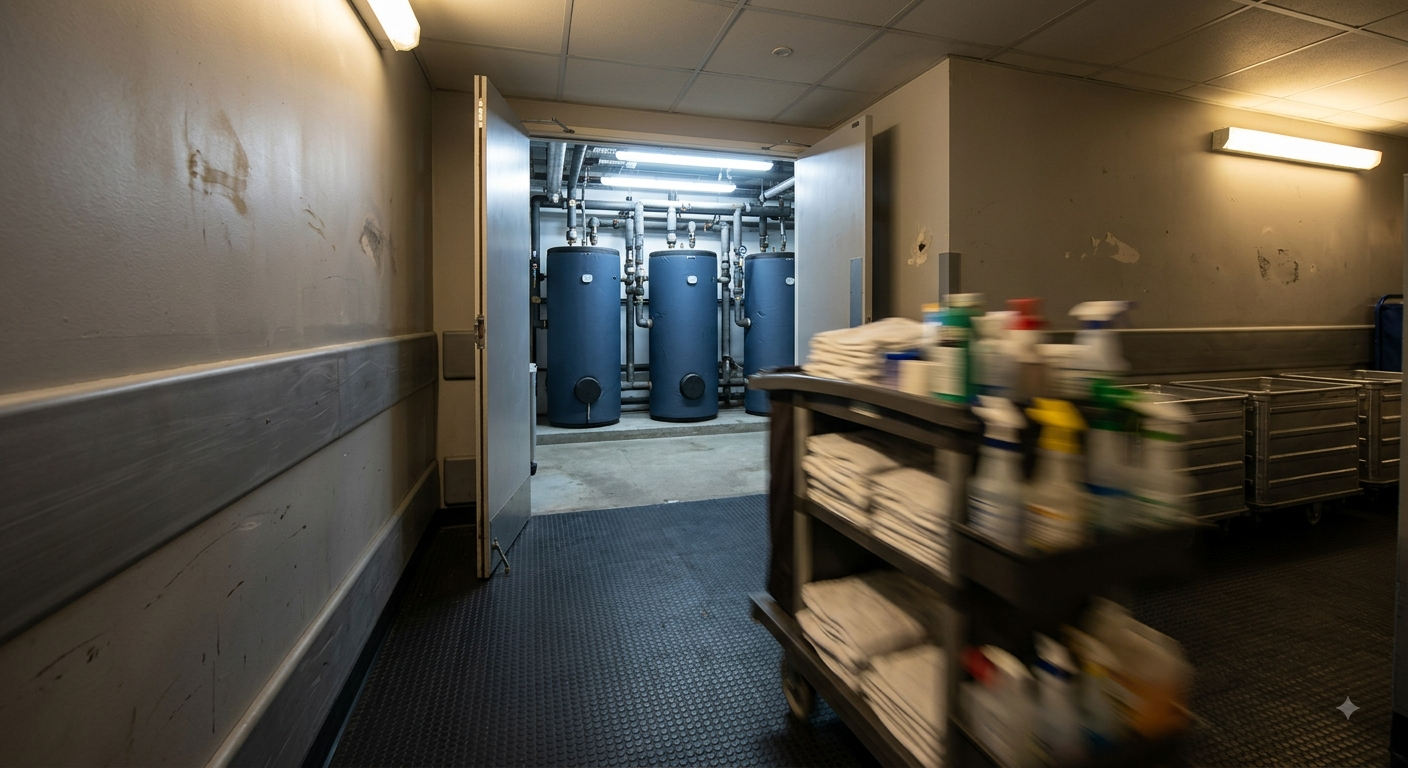
A hotel asks more of a hot water plant than almost any other commercial building. Two hundred people shower inside the same ninety minutes. The laundry runs at a temperature the guest rooms never need. Occupancy moves between forty and one hundred percent across a season. And unlike an office, there is no hour of the year when the building can be taken out of service to fix a mistake — because someone is always asleep upstairs.
In short, hotels have the most compressed domestic hot water peak of any commercial building type and the lowest tolerance for failure, which makes them an unusually strong application for thermal storage. Storage lets a smaller heat source cover a very sharp morning draw, holds capacity in reserve against a cold-shower event, and moves the plant’s electrical load off expensive hours.
The design work that is genuinely hotel-specific is load shape, turndown across occupancy swings, separate laundry and kitchen temperature requirements, storage temperature under Legionella guidance, and retrofit access in a building that never closes. The return is best underwritten the way hotel owners underwrite everything else: per available room, as an average-daily-rate equivalent, and as the effect on net operating income and therefore on asset value.
Key Takeaways
Hotels present four hot water problems at once, on different schedules and at different temperatures: guest rooms, on-premise laundry, food service and kitchens, and pools, spas, and other amenities.
The guest room peak decides the plant, but it is not the only load that matters. Laundry is the most common omission, while kitchen sanitation and amenity loads create separate temperature and scheduling requirements.
In this article
Why hotels are the hardest hot water design in commercial buildings
Most commercial buildings present one hot water problem. Hotels present four at once, on different schedules and at different temperatures.
The guest room peak is the one that decides the plant. A gas system meets it with recovery: a big burner, a small tank. A heat pump plant cannot buy recovery that cheaply, which is precisely why storage-first design applies with more force in a hotel than almost anywhere else. General sizing guidance is covered in How Commercial Hot Water Thermal Storage Improves System Performance and the thermal storage tank sizing calculator.
The laundry is the most common omission. On-premise laundry is frequently scoped separately, sized separately, and then discovered to be drawing from the same plant during the same hours as the guest peak. Establish early whether laundry is on-premise, outsourced, or partially outsourced, and whether that arrangement is stable — because a property that brings laundry back in-house after the plant is sized has a problem no control sequence fixes.
Hotel hot water loads and design consequences
LoadShapeTemperature characterDesign consequence
Guest room showersExtremely compressed morning peak, secondary evening peak; the sharpest simultaneity in commercial constructionDelivery temperature, anti-scald governedStorage, not heat source capacity, is what covers the peak economically
On-premise laundrySustained, schedule-driven, often overlapping the morning peakHigher than guest supply; sanitation requirementsCan double the plant load and is frequently omitted from early sizing
Food service and kitchenTied to service hours; dish sanitation is a distinct high-temperature drawBooster-heated above general supplyUsually served by a dedicated booster, but the base load still lands on the plant
Pool, spa, and amenityContinuous or long-duration; seasonally variableLow temperature, high volumeA candidate for heat recovery rather than primary generation
Occupancy variability: the design condition nobody sizes for
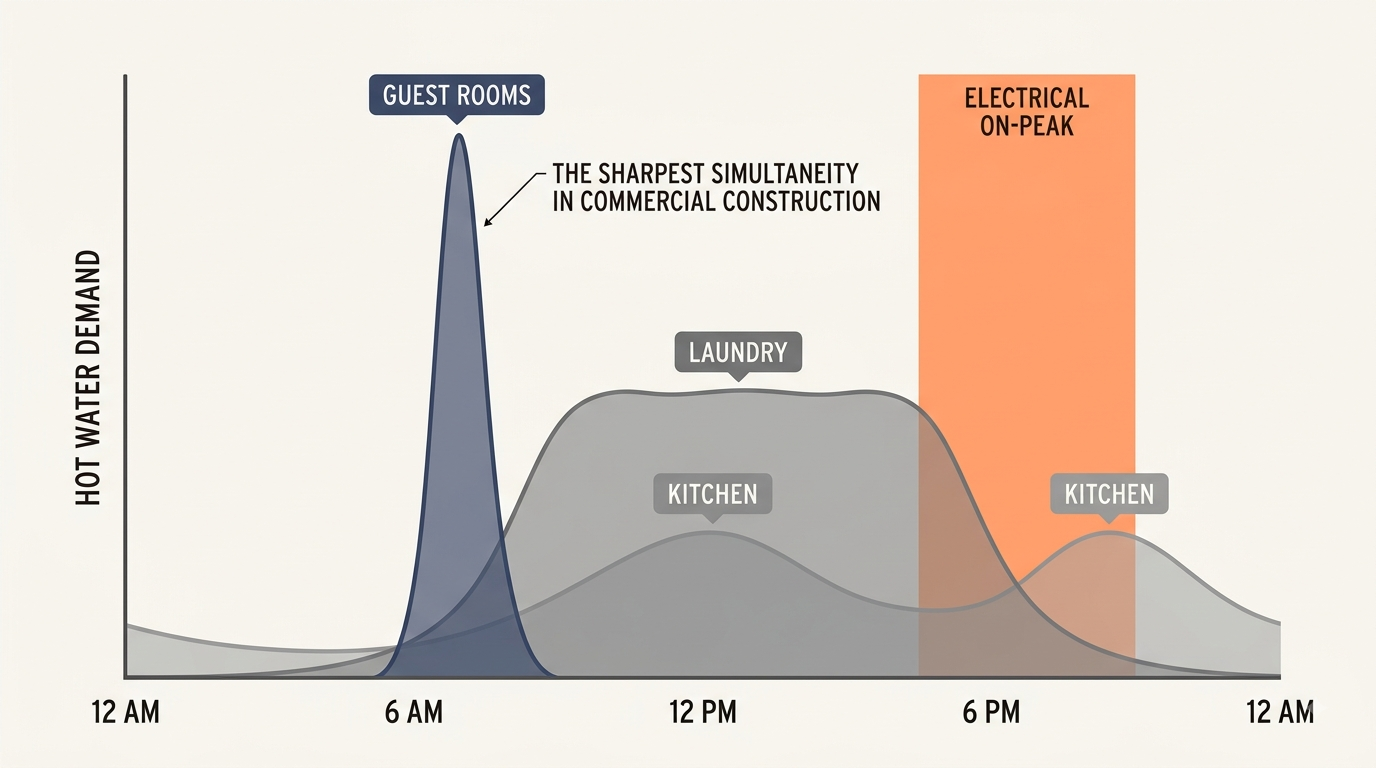
Offices are occupied on a schedule. Apartments are occupied at a roughly stable density. Hotels move between low-forties and full across a season, a week, and sometimes a night.
That creates a turndown requirement that most plant selections ignore. A system sized cleanly for a full house may spend the majority of its operating hours at part load, and heat pumps that cycle in short bursts never reach steady state — which is how an annual coefficient of performance ends up far below the number on the submittal.
Storage is the practical answer, and for a reason specific to hotels: a large tank lets the heat source run at a sensible fraction of capacity for long, uninterrupted periods regardless of how many rooms are sold. The plant charges storage rather than chasing draws.
Storage temperature, Legionella, and usable capacity
Hospitality carries specific and well-understood water management obligations, and storage temperature sits at the intersection of public health and capacity.
The CDC’s guidance on controlling Legionella in potable water systems directs building operators to store hot water above 140°F and to keep circulating hot water from falling below 120°F, while noting that anti-scald requirements must still be met — which is the function of the thermostatic mixing valve. ANSI/ASHRAE Standard 188 sets the water management program framework that many hospitality operators, insurers, and brands now treat as mandatory.
The capacity consequence works in your favour. Storing hotter increases the energy each gallon carries: at 150°F storage, 120°F delivery, and 50°F incoming water, one stored gallon blends into roughly 1.43 gallons of service hot water. A property that stores at 130°F gets about 1.14 gallons from the same tank. The same vessel is effectively 25% larger at the higher setpoint.
Two hotel-specific notes. First, long horizontal runs to distant guest wings make the recirculation loop a substantial continuous load, and loop temperature is part of the water management plan rather than just an efficiency question — the tradeoffs are in Domestic Hot Water Recirculation vs Thermal Storage. Second, rooms that sit unsold for extended periods create low-flow branches, which is a water management matter for the operator regardless of what the plant does.
Heat recovery: the opportunity hotels have and most buildings do not
Full-service hotels frequently reject heat and buy heat at the same moment. A chiller plant serving guest rooms, meeting space, and kitchen refrigeration runs while the hot water plant works, and in many properties those hours overlap substantially.
Where that overlap is real, recovering condenser heat for domestic hot water serves two loads with one machine. Where it is not, the equipment sits idle and the economics collapse. The question is entirely one of load coincidence, worked through in Heat Recovery Chillers vs Thermal Energy Storage: Why Load Coincidence Decides.
Storage is what makes recovery work. Recovered heat is available when the cooling load says so, not when guests shower. Without a tank between them, the two schedules simply do not meet.
Retrofitting a building that never closes
Hotel back-of-house is the most constrained mechanical space in commercial real estate, for a structural reason: every square foot given to plant is a square foot not generating revenue, so it was minimised when the building was designed.
The access constraint is the one that most often decides feasibility, and it is covered in detail in Designing Thermal Storage for Existing Buildings Without Major Mechanical Room Expansion.
Hotel retrofit constraints and mitigations
ConstraintHotel-specific dimensionMitigation
No shutdown windowThe building is occupied 365 nights; there is no summer breakPhase tie-ins; write temporary hot water into the bid, not the change order
Guest-facing disruptionNoise, corridor access, and service elevator use all touch the guest experienceSchedule around house count; treat low-occupancy weeks as the construction window
Mechanical room accessDoorways, freight elevator capacity, and turns were sized for the original equipmentPanelized tanks that assemble in place where a welded vessel cannot pass
Floor loadingBasements and podium levels have real structural limitsConfirm filled weight against floor capacity with structural sign-off before order
Brand and PIP timingCapital is released on renovation cycles, not on equipment failureAlign the project with the property improvement plan rather than fighting it
The redundancy argument is a revenue argument
In most buildings, a hot water outage is a comfort complaint. In a hotel it is a rate event: refunds, comped nights, and a public review that prices rooms for months. That changes how redundancy should be valued.
Storage contributes here in a way that is easy to overlook — a charged tank is stored capacity that continues to serve the building while a heat source is down or being serviced. It is not a substitute for N+1 on the plant, but it materially extends the window in which a failure is invisible to guests. Size it deliberately and say so in the business case.
How hotel owners actually underwrite this
Simple payback is the wrong opening argument in hospitality. Hotel owners and asset managers underwrite in per-room metrics and in effect on net operating income. EPA makes the point itself: in its overview of energy use and efficiency opportunities in hotels, cost reductions through energy efficiency are described as quantifiable using key financial metrics such as revenue per available room or the equivalent increase to average daily rate, and improved operating income is noted as translating to higher asset value for owners.
That same publication is the source of the most-quoted number in hospitality energy: average U.S. hotel energy spend of $2,196 per available room per year, representing about 6% of operating costs. This is EPA’s dated figure from a publication that predates the 2020s. Energy prices have moved since, and any property’s actual figure is knowable from its own operating statement. The value of the benchmark is orientation, not precision.
Thermal storage produces up to four distinct value streams, and they should be modelled separately because they depend on different things.
Demand charge mechanics — including the two tests that determine whether a shaved load actually reduces the bill — are covered in Peak Shaving vs Load Shifting.
Hotel thermal storage value streams
Value streamWhat drives itWhether it applies
Demand charge reduction$/kW on the tariff, and whether the hot water plant runs during the interval that sets the billed peakOnly if the load coincides with the billed peak — verify from interval data
Time-of-use energy arbitrageThe on-peak to off-peak spread and the kWh movedApplies wherever a meaningful spread exists
Plant and service capital avoidanceA smaller heat source and potentially a smaller electrical service upgradeOne-time; often the largest single line in a full electrification project
Revenue protectionThe cost of a hot water failure during a sold-out morningReal but property-specific; quantify with the operator, do not assume
A worked example: 200-room full-service property
Illustrative only, and deliberately built from metered plant demand rather than from a gallons-per-room table. Published hotel hot water benchmarks vary enormously by service level and laundry configuration; the reliable input is the property’s own meter. Every figure below would need to be replaced with site data before it appears in a pro forma.
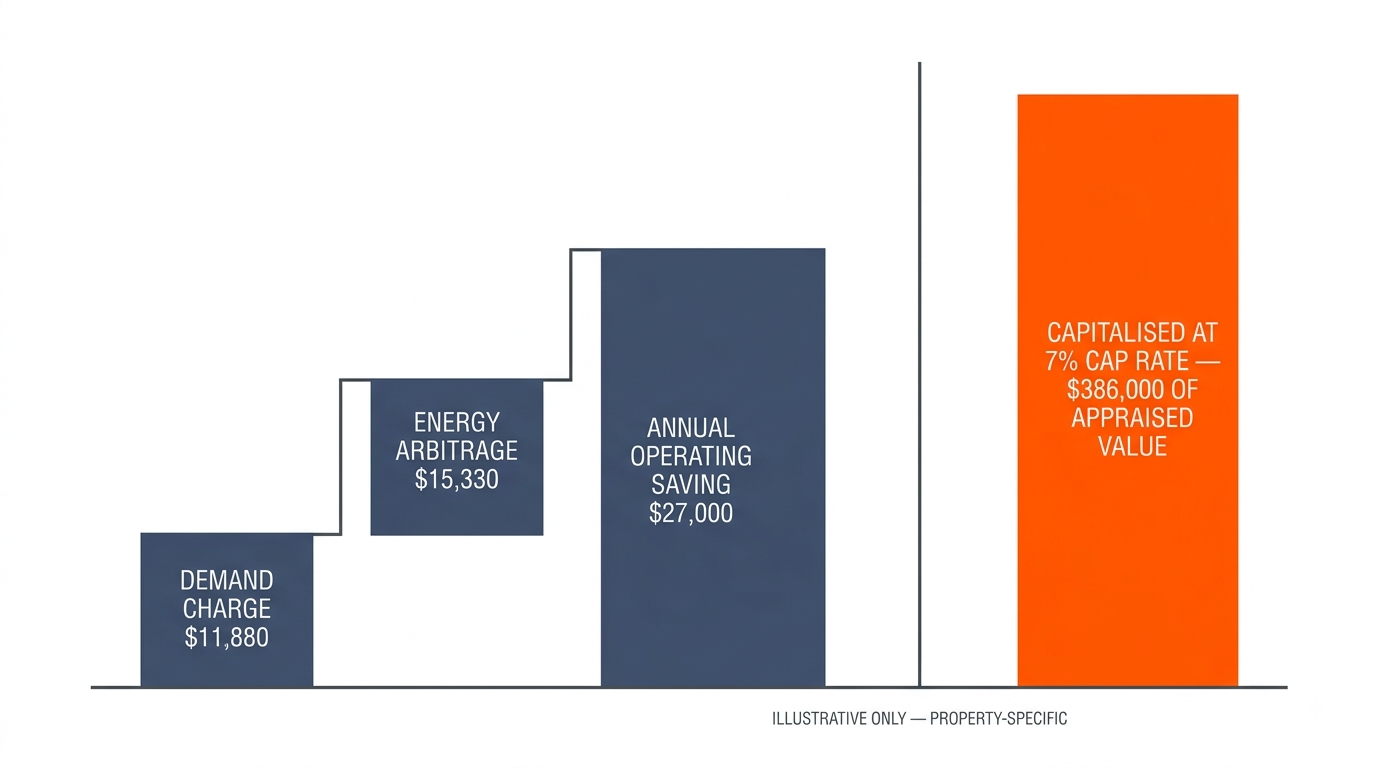
Property: 200 rooms, 70% annual occupancy, full service with on-premise laundry. Tariff: $18/kW on-peak demand charge, 4–9 p.m. on-peak window, $0.12/kWh on-peak to off-peak energy spread. Metered: the central hot water plant draws 55 kW during the on-peak window and moves roughly 350 kWh per day of its consumption if storage allows it to shift.
Demand reduction: 55 kW × $18/kW = $990 per month, or about $11,880 per year — subject to two tests: does the plant actually run during the interval that sets the billed peak, and what is the next-highest interval that month? Savings equal the gap to that next interval, not the kilowatts removed.
Energy arbitrage: 350 kWh/day × $0.12 = $42/day, or about $15,330 per year.
Combined annual operating saving: roughly $27,000.
Per available room: $27,000 ÷ 200 = $135 per available room per year. Against EPA’s dated $2,196 benchmark, that is on the order of 6% of the property’s energy spend — from one system.
As an ADR equivalent: at 70% occupancy the property sells about 51,100 room-nights a year, so $27,000 is roughly $0.53 per occupied room night. That is the number to put in front of a general manager, because it is denominated in the unit they manage.
As asset value: $27,000 of durable annual NOI capitalised at a 7% cap rate is approximately $386,000 of appraised value — against a storage scope that is a fraction of that. This is the number to put in front of an asset manager or a lender.
The caveat that makes the last number honest
Operating savings only capitalise into value if they are durable and visible in the operating statements. That requires the savings to persist — which requires controls, alarming, and someone accountable for the system — and it requires measurement and verification good enough that an appraiser or buyer accepts the line. A saving that exists in a model but not in the P&L does not capitalise.
This is not investment or valuation advice, and cap rates are property- and market-specific. The point is the structure of the argument: in hospitality, recurring operating savings are worth a multiple of themselves, and that multiple is usually far more persuasive than a payback period. Payback structure is worked through in the thermal energy storage ROI calculator.
What the storage costs
The following are vessel prices, not installed system prices. Pricing is current as of August 2026; verify against the live thermal tank comparison and specifications.
Thermal storage vessel pricing and performance
ModelList price$/kWh storedStorage capacity*Standing loss
80 gallon$1,190$9712.0 kWh7–8°F / 24 hr
350 gallon$3,427$6354.6 kWh3.8°F / 24 hr
500 gallon$4,464$5877.0 kWh3.0°F / 24 hr
700 gallon$5,798$54108.0 kWh2.4°F / 24 hr
What is included beyond the vessel
A complete system adds the heat source, heat exchangers, piping, controls, seismic restraint, and the general conditions of working in an occupied hotel, which are not trivial. Full cost structure is in How Much Does Thermal Energy Storage Cost?, and packaged assemblies that reduce on-site work in a live property are in the All-In-One thermal energy system.
The standing loss column matters more in hospitality than elsewhere: a tank charged overnight and drawn against a 6 a.m. peak has held its charge for six hours, and a tank charged overnight to ride through a 4–9 p.m. tariff peak has held it for sixteen. Standing loss consumes the usable band between storage and delivery temperature, not a percentage of the tank — which is why it deserves more attention than it usually gets. Detail is in What Is the Best Thermal Energy Tank? The 7 Specs That Actually Decide It.
On incentives, the statutory definition of energy storage technology under 26 U.S.C. §48E expressly includes thermal energy storage, and the IRS Clean Electricity Investment Credit governs qualifying property placed in service after December 31, 2024. Eligibility depends on project facts, prevailing wage and apprenticeship compliance, and sourcing rules — confirm with a tax professional. Many utilities also run custom commercial programs paying on measured demand reduction; those generally require interval data, which is a second reason to meter before designing. Program managers can start at the Thermal Energy HQ utilities and programs page.
A feasibility screen for a hotel property
Use these questions to establish whether a property is a good candidate and what the design must address.
Project references
Examples of how these tradeoffs resolved on built projects are in the case studies, with specification sheets in the technical documentation library.
Frequently Asked Questions
Why is thermal energy storage a good fit for hotels?
Because hotels have the most compressed hot water peak of any commercial building type. Guest room showers concentrate into a short morning window with very high simultaneity, which means meeting that peak with heat source capacity alone requires equipment that sits largely idle the rest of the day. Storage lets a smaller heat source run longer and cover the peak from a charged tank, while also allowing the plant to shift its electrical load off expensive hours and holding reserve capacity against a hot water failure during a sold-out morning.
How much do hotels spend on energy?
EPA's ENERGY STAR hospitality overview reports average U.S. hotel energy spend of $2,196 per available room per year, representing roughly 6% of operating costs. That publication predates the 2020s and is not recent, and energy prices have moved since, so treat the figure as orientation rather than precision. Any individual property's actual spend is knowable from its own operating statement and utility bills.
How should hotel owners evaluate the return on a thermal storage project?
In the metrics they already use. Express annual savings per available room, as an equivalent increase to average daily rate, and as the effect on net operating income. EPA itself notes that efficiency cost reductions can be described using revenue per available room or the equivalent average daily rate increase, and that improved operating income translates to higher asset value. Recurring savings capitalise at the property's cap rate, which is usually a far more persuasive number than a simple payback period.
Does a hotel's occupancy variability affect the design?
Substantially. Occupancy can move between roughly forty and one hundred percent across a season, and a plant sized cleanly for a full house may spend most of its hours at part load. Heat pumps that cycle in short bursts never reach steady state, which drives annual efficiency well below the rating. Specify part-load performance, stage multiple smaller units rather than one large one, and control on tank state of charge rather than on a fixed schedule.
What temperature should a hotel store domestic hot water at?
CDC guidance for potable water systems directs storing hot water above 140 degrees Fahrenheit and keeping circulating hot water above 120 degrees, with a thermostatic mixing valve handling anti-scald compliance at delivery. ANSI/ASHRAE Standard 188 sets the water management program framework. Higher storage temperature also increases usable capacity: at 150 degrees storage, 120 degrees delivery, and 50 degrees incoming water, one stored gallon blends into roughly 1.43 gallons of service hot water.
Does hotel laundry change the hot water design?
Often decisively. On-premise laundry runs a sustained, schedule-driven load at a higher temperature than guest supply, and it frequently overlaps the morning guest peak. It is one of the most common omissions in early sizing. Establish whether laundry is on-premise, outsourced, or partially outsourced before the plant is sized, and confirm whether that arrangement is expected to stay the same.
Can a hotel recover heat from its chiller plant for hot water?
Where the loads overlap in time, yes, and full-service hotels often reject heat and buy heat during the same hours. A heat recovery chiller can serve cooling and domestic hot water from one machine. The economics depend almost entirely on how many hours the two loads actually coincide, and thermal storage is usually what makes it work, because recovered heat becomes available when the cooling load dictates rather than when guests shower.
Can a hot water retrofit be done in an occupied hotel?
Yes, with sequencing designed for it. Temporary hot water, phased tie-ins, service elevator scheduling, and access notice belong in the bid documents rather than in a change order. Low-occupancy weeks are the practical construction window. Where mechanical room doorways and freight access will not admit a welded vessel, panelized tanks that assemble inside the room are the standard workaround.
Conclusion
Hotels are an unusually good application for thermal storage for an unglamorous reason: the peak is sharp, the tolerance for failure is low, and heat source capacity is the expensive way to solve both. A charged tank covers the morning, absorbs the occupancy swing, buys the plant a smaller electrical service, and holds reserve for the night something breaks.
Design it around the four loads the property actually has, not the one everyone thinks of. Meter before you size. Get laundry on the table in the first meeting. And when the business case goes to the owner, write it in per-available-room, average-daily-rate, and net-operating-income terms — because recurring savings in hospitality are worth a multiple of themselves, and that is the argument that gets capital released.