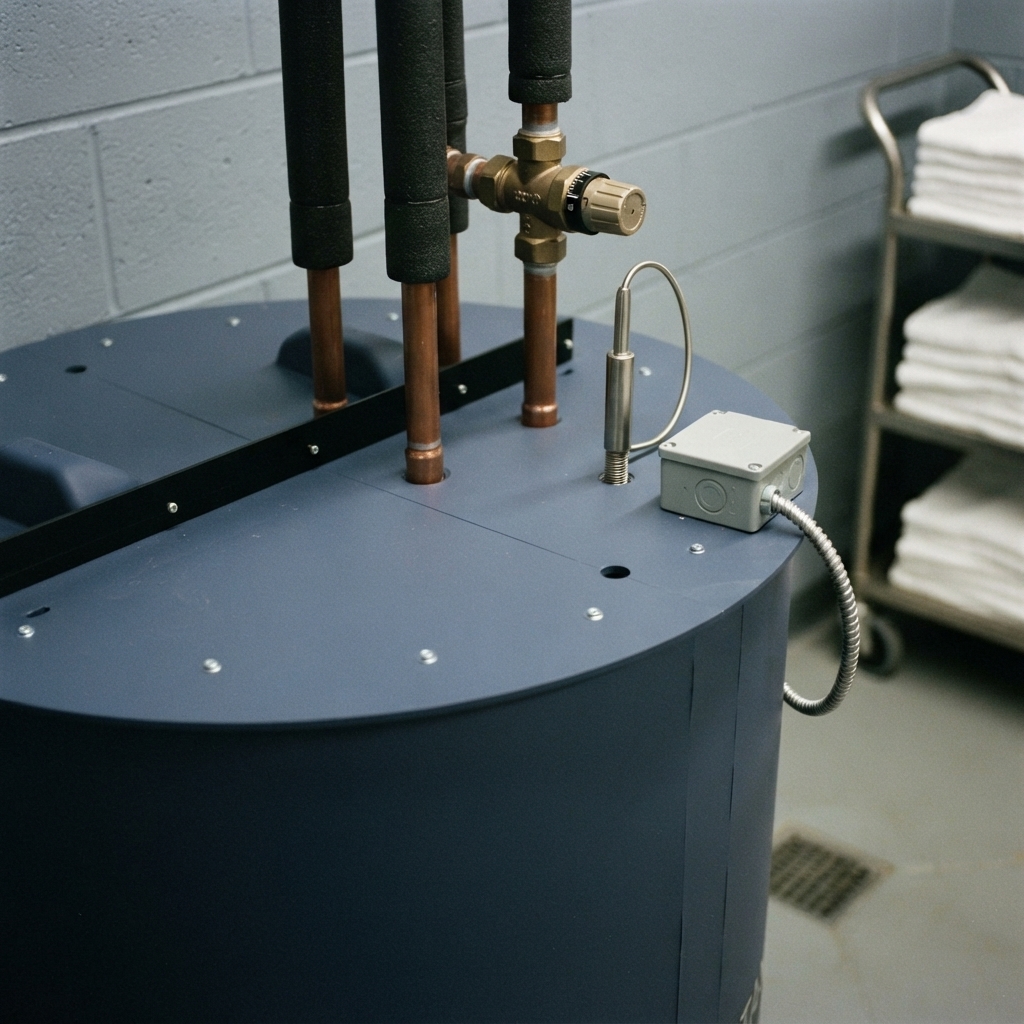
The evening locker-room rush is an electrical constraint before it is a plumbing one.
Thermal energy storage for fitness clubs and gyms addresses the concentration of domestic hot water demand inside the most expensive tariff window. A club can meet the shower peak from stored hot water while an air source heat pump replaces the day's thermal energy during an eight-hour off-peak charging window.
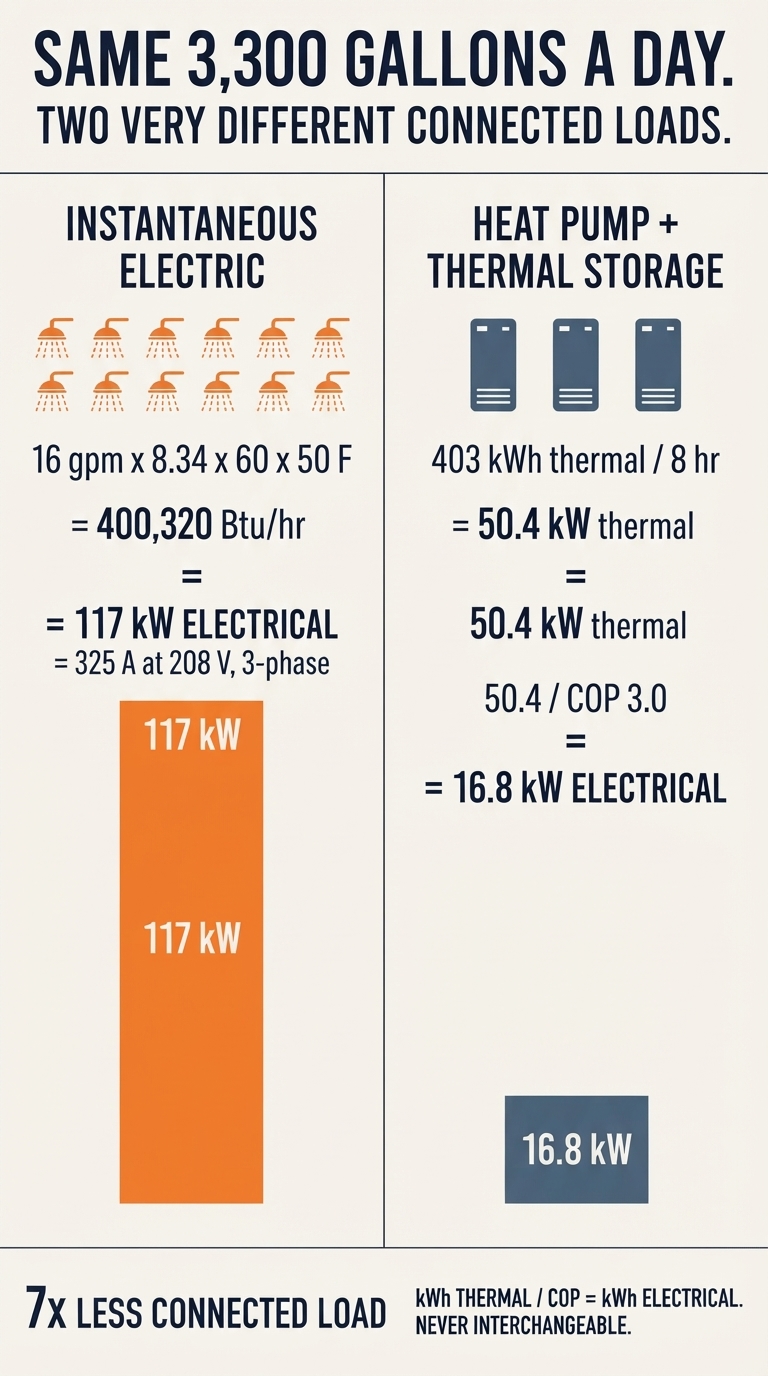
The worked example below reduces connected load from 117 kW electrical for instantaneous resistance heating to 16.8 kW electrical for heat pump charging. It does not reduce the total thermal energy required to heat water, back up non-thermal loads, heat a pool basin, or shift sauna and steam-generator loads.
Key Takeaways
A club's annual hot water volume is unremarkable for its floor area, but roughly one-third of that volume moves in three to five hours inside the most expensive tariff window. The usual response, a bank of electric tankless heaters, meets the simultaneous flow requirement by adding more than 100 kW of connected load to a service already sized for rooftop units.
The alternative is to charge a stratified thermal storage array during off-peak hours and discharge it through the evening rush. This article works through the sizing math, connected-load comparison, demand-charge value, and operating limits. It does not claim that storage reduces the total energy a club uses to heat water, and it does not address pool basin heating.
In this article
The evening rush is concentrated enough to set the month's demand charge
Club traffic is bimodal, and the evening lobe is the larger one. Club Pilates recorded the smallest share of visits between 5:00 p.m. and 8:00 p.m., at 16.5 percent, followed by Orangetheory at 17.3 percent and Burn Boot Camp at 18.7 percent. The same analysis put the early-morning block at 8.9 percent for LA Fitness, so even the best-flattened chain places roughly twice as much traffic into the evening block as into the morning one.
Showers lag arrivals by the length of a workout, so demand crests between 6:00 p.m. and 8:30 p.m. on weekdays. In California, that period sits inside the 4:00–9:00 p.m. on-peak period. Elsewhere, it overlaps the summer on-peak block by at least two hours.
The U.S. Energy Information Administration models water heating as a separate end use in the Commercial Buildings Energy Consumption Survey. The survey models required hot water from building activity and size before converting it to energy.
The billing mechanic that matters is the demand charge. Commercial tariffs bill the highest fifteen-minute average demand in the period, in dollars per kilowatt, separately from consumption. Many tariffs ratchet that peak into later months. One evening in which every shower runs at once can set what the club pays for the entire month.
Pacific Northwest National Laboratory treats storage as one of four required components in its commercial heat pump water heater work: primary air-to-water heat pumps, primary thermal storage tanks, a temperature maintenance system, and grid-connected controls.
Storage decouples gallons per minute from kilowatts drawn
A thermal storage array converts a power problem into an energy problem. Instantaneous heating supplies the full heat rate demanded by the fixtures at the moment of use, so connected load scales with simultaneous flow. A charged array supplies that heat rate from water already hot, leaving the heat pump to replace only the day's total thermal energy.
The mechanism is stratification. In a 700-gallon modular TES module, the coldest water sits at the bottom and is drawn from there as the input to the air source heat pump. Hot output is introduced at the top of the coil. Transfer runs through a dual-loop 32 mm DN corrugated stainless steel tubing heat exchanger, so potable shower water never mixes with the heat pump loop.
Every connection enters and leaves through the top head plate. No penetration is made through a side panel. Where the plant also carries a cooling load, the flow path reverses in cooling mode.
Withdrawal temperature is the design constraint, and code sets it. Storage is held at 140°F to suppress Legionella growth, then blended at a thermostatic mixing valve to the 105°F delivered to showers. CDC's water management program guidance and ANSI/ASHRAE Standard 188 both treat maintained storage temperature as a primary control measure. This matters in a locker room because showers aerosolize water.

A club therefore cannot use a module's full nameplate delta. Once the top of the tank falls below roughly 110°F, the mixing valve loses the authority to hold 105°F at the shower head.
Control is a Modbus register interface that drives time-of-use scheduling. The array charges against the tariff calendar and the club's own check-in curve. A 10 kW immersive electrode element per tank provides backup and doubles as a photovoltaic load dump. The recirculation tradeoff is addressed in domestic hot water recirculation versus thermal storage.
What thermal storage will not do for a club
Storage is a scheduling asset with a narrow job description. Six limits belong on the table before any arithmetic.
How the approaches compare in a club
Storage is sized for simultaneity, not annual volume
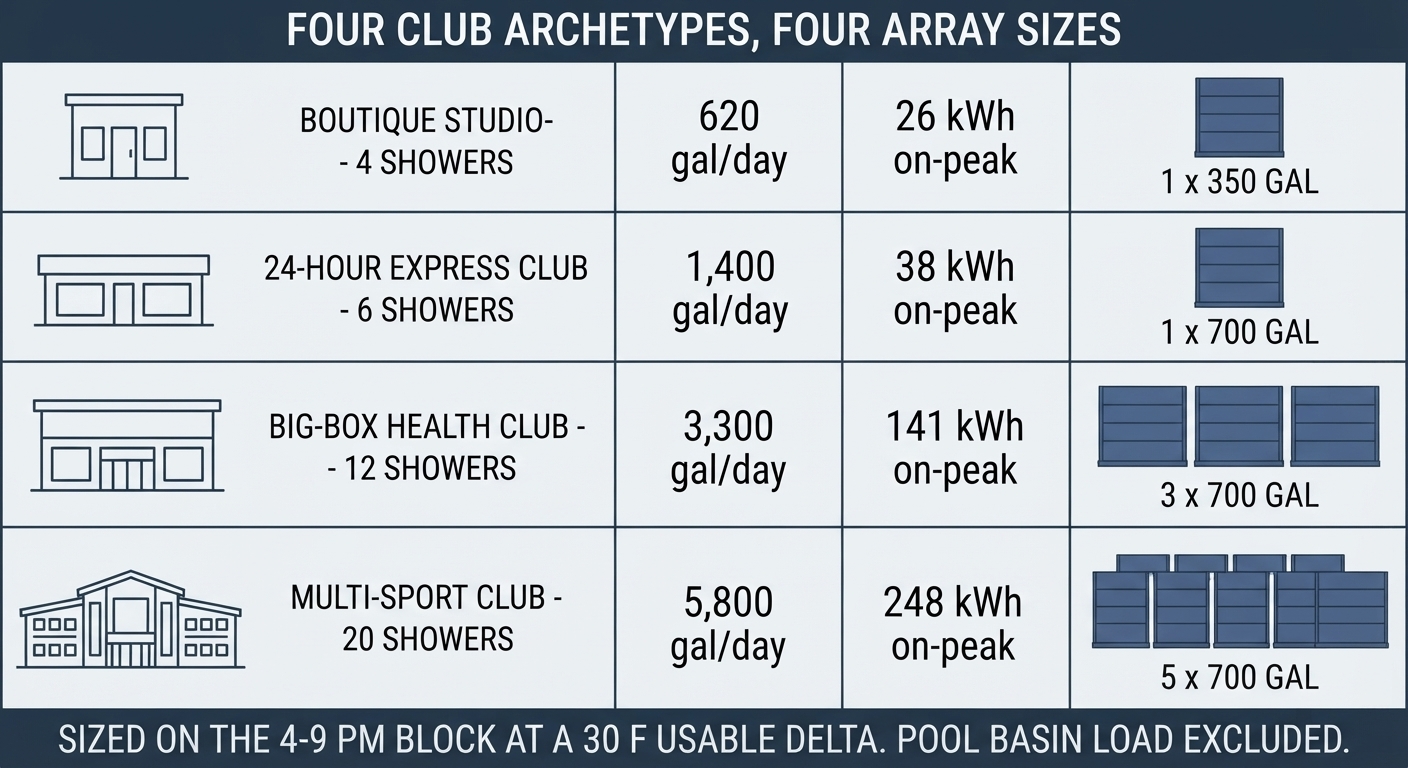
An array is bought to fix simultaneity rather than annual volume. A 24-hour express club with a flat draw profile gets far less from storage than a 45,000 square foot club that empties both locker rooms between 6:00 and 8:00 p.m.
The test in peak shaving versus load shifting applies. Where a club runs simultaneous heating and cooling, heat recovery chillers versus thermal energy storage is the better starting point.
Two numbers set the tank count: peak-block gallons and usable delta
Sizing an array requires the volume drawn inside the on-peak window and the span across which the array can deliver useful heat.
The worked example is a 45,000 square foot club with 3,200 members, twelve showers, and operating hours from 5:00 a.m. to 11:00 p.m.
Assumption set: 220 showers per day at 7.5 minutes and 2.0 gpm deliver 3,300 gallons per day at 105°F from a 55°F inlet, a 50°F rise. Storage setpoint is 140°F, blended to 105°F. Usable delta is 30°F down to the 110°F mixing-valve floor. Heat pump COP is 3.0. The off-peak charging window is eight hours. The on-peak window is 4:00–9:00 p.m. and carries 35 percent of daily volume. Replace every figure with metered club data before quoting.
Step 1. Daily thermal energy in the domestic hot water load.
Q_day = V × ρ × c × ΔT
V = 3,300 gal/day; ρ = 8.34 lb/gal; c = 1 Btu/lb·°F; ΔT = 50°F, calculated as 105°F delivered − 55°F inlet.
Q_day = 3,300 × 8.34 × 1 × 50 = 1,376,100 Btu/day = 403 kWh thermal per day.
Step 2. Electrical energy represented by the thermal load.
Thermal kilowatt-hours are divided by COP to obtain electrical kilowatt-hours. The two quantities are not interchangeable.
E_day = Q_day ÷ COP
E_day = 403 kWh thermal ÷ 3.0 = 134 kWh electrical per day.
Step 3. Connected load if the same duty is met instantaneously, with eight of twelve showers running at the crest.
P_inst = V̇ × 8.34 × 60 × ΔT
V̇ = 8 showers × 2.0 gpm = 16 gpm
P_inst = 16 × 8.34 × 60 × 50 = 400,320 Btu/hr = 117 kW thermal.
Electric resistance, COP ≈ 1.0, therefore requires 117 kW electrical.
At 208 V three-phase: I = 117,000 ÷ (1.732 × 208) = 325 A.
Step 4. Connected load if the same duty is met from storage.
The heat pump replaces the day, not the peak.
P_charge,thermal = Q_day ÷ t_charge = 403 ÷ 8 = 50.4 kW thermal.
P_charge,elec = 50.4 ÷ 3.0 = 16.8 kW electrical.
117 kW ÷ 16.8 kW = 7.0× less connected load for the same 3,300 gallons per day.
Step 5. Module count from the on-peak block.
Capacity is stated at the delta at which the module was rated. A 700-gallon module publishes 108 kWh across a 63°F (35°C) delta and delivers less across the 30°F delta available in the locker room.
Q_module = 700 × 8.34 × 1 × 30 = 175,140 Btu = 51.3 kWh thermal usable, against the 108 kWh nameplate at the 63°F rating delta.
Q_peak = 0.35 × 403 = 141 kWh thermal in the 4:00–9:00 p.m. window.
n = 141 ÷ 51.3 = 2.75 → 3 × 700-gallon modules.
Array = 154 kWh thermal usable, with a 9 percent margin and 2,100 gallons of storage volume.
Sensitivity to the mixing-valve floor
Hold the mixing-valve floor at 115°F instead of 110°F. Usable delta falls to 25°F, module capacity drops to 42.8 kWh thermal, and the count rises to 3.3, which rounds to four modules.
Five degrees of usable delta is one whole module on this club. Rounding runs against the client throughout, with shower duration and simultaneity set at the high end of observed practice.
Module pricing is presented in the modular thermal tank overview, and the arithmetic runs interactively in the thermal storage tank sizing calculator.
Where the savings actually land in a club's P&L
Four value channels carry the case, and they are not equal. The demand charge line is usually the largest and the least often modeled.
Project cost and verification
Storage hardware for the three-module array is $17,394 at list. Complete project cost also carries the heat pump, heat exchanger, pumps, valves, controls, and installation. Those items govern payback.
The method is in the thermal energy storage ROI calculator, with current module pricing in the 2026 thermal energy storage tank price guide. The club should verify these figures with its engineering services before the project proceeds.
What the 2026 rules require of a 45,000 square foot club
Most big-box clubs now sit inside a building performance standard. Sixteen such laws were active across United States cities, counties, and states as of July 2026, with covered-building thresholds typically between 10,000 and 50,000 square feet. A 45,000 square foot club clears the benchmarking threshold in most of these jurisdictions.
Washington's Clean Buildings Performance Standard set its Tier 1 deadline at June 1, 2026, for buildings above 220,000 square feet. Building Performance Colorado covers buildings at 50,000 square feet and above, targeting a 7 percent emissions reduction by 2026 and 20 percent by 2030 against a 2021 baseline.
Two federal items need checking against the calendar rather than memory. The Section 179D deduction is terminated for construction beginning after June 30, 2026.
On Section 48E, this article makes no eligibility claim for a thermal storage array. The regulatory definition of thermal energy storage property may not extend to tanks serving only domestic hot water. That question belongs with tax counsel.
FERC Order 2222 aggregation timelines continue to move by market. Check the commission's explainer on publish day.
Legionella management is the regulatory item most specific to this building type and the least likely to be included in the energy conversation. A locker room is a high-aerosolization environment serving a population that includes older and immunocompromised members.
Lowering storage temperature to chase efficiency runs against ANSI/ASHRAE Standard 188 practice. The water management program should be reviewed alongside the mechanical design.
What to check before signing a water heater replacement
Run these seven items before accepting a quotation. Each is answerable from data the club already holds or can pull in a week.
Frequently Asked Questions
How much hot water does a gym use per day?
A 45,000 square foot club with 3,200 members typically draws 3,000 to 4,000 gallons per day at shower temperature, from about 220 showers at 7.5 minutes and 2.0 gpm. Towel laundry and janitorial use add 10 to 20 percent. The share drawn inside the on-peak window governs sizing.
Can thermal storage replace tankless water heaters in a fitness club?
Yes, and the reason is electrical rather than hydraulic. A tankless bank sized for eight simultaneous showers at a 50°F rise draws roughly 117 kW electrical, or 325 A at 208 V three-phase. A heat pump charging a storage array across eight hours covers the same 3,300 gallons per day at about 17 kW electrical.
How many thermal storage tanks does a gym need?
Divide the thermal energy drawn inside the on-peak window by the usable thermal capacity of one module. For the worked club, 141 kWh thermal in the 4:00–9:00 p.m. window divided by 51.3 kWh thermal usable per 700-gallon module at a 30°F delta gives 2.75, which rounds up to three modules.
Does thermal energy storage work for a gym with a swimming pool?
Not for the pool itself. A pool basin is a continuous, high-volume, low-delta load running well below domestic hot water storage temperature, so a 140°F array is the wrong tool. Storage still serves locker-room showers and other domestic hot water loads. A competition pool needs a separate thermal plant.
What temperature should a gym store domestic hot water at?
Store at 140°F and blend down to 105°F at a thermostatic mixing valve. CDC water management guidance and ANSI/ASHRAE Standard 188 both treat maintained storage temperature as a primary Legionella control, and locker-room showers aerosolize water. Storing cooler also shrinks the usable delta the array can deliver across.
Conclusion
The arithmetic points in one direction. A club draws one-third of its daily hot water inside the hours the utility prices highest, and the instantaneous answer to that concentration prices itself into service capacity and the demand charge permanently.
Splitting the requirement—flow from the array and energy from the heat pump—cuts the worked club's connected load from 117 kW electrical to 16.8 kW electrical for the same 3,300 gallons per day. The array uses three 700-gallon modules sized from the on-peak block across a 30°F usable delta.
The limits stand: no export, no backup for non-thermal loads, one cycle per day, and no pool basin heating. Within those limits, the club buys back the most expensive hours of its operating day.