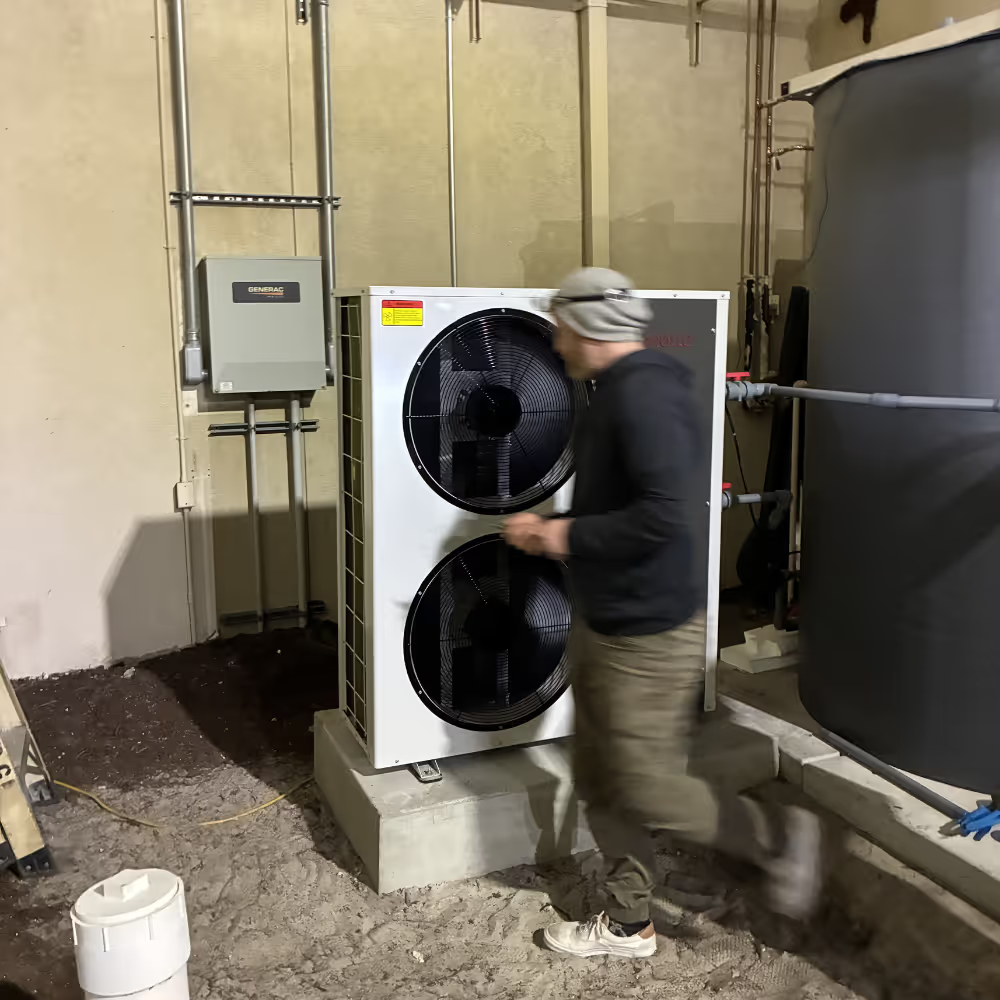
A gas water heater draws almost nothing from the electrical service. The heat pump that replaces it draws tens of kilowatts, so the first engineering question is whether the existing service can carry it or whether the project requires a utility service upgrade, new switchgear, and a schedule measured in months.
The National Electrical Code offers two ways to answer. NEC Article 220 permits a nameplate calculation with demand factors, while NEC 220.87 can use measured maximum demand multiplied by 125 percent, with the new equipment added at full rating.
A central heat pump water heater sized to the recovery rate of the boiler it replaces draws about twice the power of one sized to the daily load with thermal storage. In the 100-unit example below, the difference is about 34 kW against about 16 kW.
The measured-demand findings cited in this article are residential. They do not establish demand factors for a multifamily central water heating plant. The design application is narrower: use the building's qualifying measured demand where permitted, then select a plant size and storage volume that avoid adding unnecessary connected kW.
The NEC descriptions are taken from the LBNL presentation Low-Power Electrification, the NEC and Building Energy Codes and the LBNL and ACEEE paper by Less and Walker. The article does not quote NEC text directly. The adopted code edition and the authority having jurisdiction govern, and the licensed electrical engineer makes the calculation.
Two ways the code counts an existing load
Article 220 of the NEC covers branch circuit, feeder, and service load calculations. For an existing building that is adding load, LBNL's April 2024 webinar for the DOE building energy codes program describes two routes.
Commercial and multifamily buildings follow the same two structures: a nameplate-based calculation under the general provisions of Article 220, or the measured-demand method of 220.87 where qualifying demand data exist. Which method applies, what data qualify, and how the result is documented are decisions for the licensed electrical engineer under the edition adopted by the jurisdiction. Nothing in this article substitutes for that calculation.
The nameplate method
For existing dwelling units, NEC 220.83 sums the nameplate ratings of installed equipment after an inspection. It applies 100 percent to the first 8,000 W and 40 percent to the remainder when no new HVAC is added, and adds the larger of the heating or cooling load when it is.
LBNL's example home of 2,000 square feet on a 100 A service computes to 15,432 W, or about 65 A at 240 V. The example includes 6,000 W of lighting and receptacles at 3 W per square foot, 4,080 W of HVAC at 100 percent, and a 2,880 W heat pump water heater counted at 40 percent, or 1,152 W.
LBNL calls this an asset rating. It describes what is installed, not what is drawn.
The measured-demand method
NEC 220.87, as summarized by LBNL, establishes the existing load as the measured maximum demand multiplied by a 1.25 safety factor. The new load is added at 100 percent of nameplate.
LBNL's example uses a 4,000 W measured peak and 5,000 W after the factor on a 100 A, 240 V panel rated at 24,000 W. That leaves about 19 kW for new equipment at full nameplate.
LBNL notes that the 2023 edition extended 220.87 to homes with photovoltaics or demand response when at least one year of data is available. The method yields a smaller existing load but allows less new load per step, and it suits adding one or two loads or adding loads over time.
What the field data say about nameplate versus measured
The nameplate method's weakness is diversity. LBNL analyzed 11,750 dwellings and found that most have substantial room for new loads, that new loads add at less than 100 percent of their nameplate, and that load diversity runs about 40 to 50 percent and increases as more loads are connected. The analysis found that never do more than four loads operate at or near 100 percent together. Appliance maximum draw was below nameplate across the sample.
The heat pump paper by Less and Walker at the 2024 ACEEE Summer Study quantifies the residential effect. Across 9,093 Vermont homes with smart meter data before and after a cold-climate heat pump installation, the median change in whole-home maximum demand was 0.20 kW against a typical 3.6 kW rated heat pump. The multi-year average was 0.36 kW, and roughly equal numbers of homes saw demand rise and fall.
Expressed as a demand factor, the median was 5 percent, the 75th percentile was 31 percent, and the 90th percentile was 69 percent. In 957 sub-metered homes from the Pecan Street and NEEA datasets, where the heat pump load could be isolated, the factor was about 60 percent overall and about 24 percent for ductless systems. Five heat pumps in the sample reached 100 percent.
These are residential space-heating figures, not central water heating plant demand factors. The narrower lesson is that a method starting from what the building measurably draws can find more room than a calculation based only on installed nameplates.
- At a 24 kW threshold for a 100 A service, assuming 100 percent of nameplate flagged 5.5 percent of homes for an upgrade: 5.42 percent were unnecessary and 0.11 percent were necessary.
- At a 50 percent factor, 1.6 percent were flagged: 1.50 percent were unnecessary and 0.07 percent were necessary.
- Homes left on a 100 A service whose measured demand exceeded 24 kW were 0.19 percent at the 50 percent factor and 0.14 percent at the 100 percent factor.
- The authors argue that because 220.87 already pads measured demand by 25 percent, the calculation carries its own margin.
What a multifamily meter shows
Steven Winter Associates' June 2022 report for NYSERDA, Multifamily Building Electric Heating Demand Profile Analysis, measured whole-building electric heating demand in New York multifamily buildings.
For older electric-resistance buildings, the report estimated heating peaks at 5 F of 2.2 to 4.6 W per square foot, averaging 3.8 W per square foot. At one site, the Manual J design load was about 6 W per square foot while the measured peak was less than half of that. At a Passive House site, the comparison was about 2.3 W per square foot calculated against 0.49 W per square foot measured.
The report describes whole-building demand as masking significant diversity among apartments. Some units heated nearly flat out in mild weather while others drew little in severe cold.
Water heating was outside the study. The report states that domestic water heating would add to the measured profiles and could affect the overall peak, most likely in the early morning when water heating load is typically highest.
A heat pump water heater sized to recover at the shower peak adds its full rating to the building's peak demand at the hour the building can least afford it. A 220.87 calculation also adds it at 100 percent of nameplate on top of the measured maximum. A plant that charges storage overnight adds its rating when the meter shows the building near its minimum, and its nameplate is smaller.
The 100-unit example
The following example uses labeled assumptions. It is arithmetic on those assumptions, not a substitute for the building's measured data or the engineer's electrical calculation.
- 100 apartments with central domestic hot water and a gas boiler being replaced.
- Recovery sizing basis: 5 gallons per hour per unit for 51 to 100 units, from the PNNL-34990 Rev. 2 technical brief, Table 2, which proposes service water heating target systems for ASHRAE 90.1-2022.
- Temperature rise: 70 F, from 55 F inlet to 125 F delivery.
- Daily consumption basis: 10.1 million Btu per apartment per year of water heating fuel from EIA RECS 2020 Table CE3.1, with an assumed 80 percent boiler efficiency.
- Heat pump annual COP: 2.5, a labeled assumption inside the 1.9 to 3.2 system COP range measured at five California multifamily sites.
- Charging window with storage: 16 hours.
- Service: 208 V or 480 V three-phase. Amps are approximated as kW × 1,000 / (V × 1.732) at unity power factor.
Plant sized to the recovery rate, no storage credit
- Recovery: 100 units × 5 gal/h = 500 gal/h.
- Heat: 500 gal/h × 8.34 lb/gal × 1 Btu/lb-F × 70 F = 291,900 Btu/h.
- 291,900 Btu/h / 3,412 Btu/kWh = 85.5 kW thermal.
- Electric resistance at an efficiency of 1.0: 85.5 kW electrical, about 237 A at 208 V or 103 A at 480 V.
- Heat pump at COP 2.5: 85.5 kW thermal / 2.5 = 34.2 kW electrical, about 95 A at 208 V or 41 A at 480 V.
Plant sized to the daily load with storage
- Daily heat delivered per apartment: 10.1 million Btu × 0.80 / 365 = 22,137 Btu per day.
- Building: 100 × 22,137 = 2,213,700 Btu per day = 649 kWh thermal per day.
- Plant output over a 16-hour window: 649 kWh thermal / 16 h = 40.6 kW thermal.
- Heat pump at COP 2.5: 40.6 kW thermal / 2.5 = 16.2 kW electrical, about 45 A at 208 V or 20 A at 480 V.
- Over a 24-hour window, the plant falls to 27.0 kW thermal and 10.8 kW electrical.
Storage to carry the peak
The smaller plant works only if storage covers the difference between its 40.6 kW thermal output and the morning draw. The PNNL Table 2 pairs the 5 gallon per hour recovery rate with 14 gallons of storage per unit, or 1,400 gallons for 100 units.
Two 700-gallon Thermal Tank modules hold 216 kWh thermal at a 35 C (63 F) delta. That is one-third of the day's load. At a smaller usable delta, the count rises.
The method for sizing to peak hot water demand and the heat pump water heater sizing article set the volume from the building's own draw profile rather than from the code-overlay value.
Each module is 60 inches in diameter, 88.6 inches tall, and 6,046 lb filled, assembled from panels inside the room.
Against a constrained service
A 600 A, 208 V three-phase service is rated at about 216 kW. If the building's twelve-month metered maximum demand is 140 kW, the 220.87 existing load is 140 × 1.25 = 175 kW. That leaves about 41 kW for new equipment at 100 percent of nameplate.
- Resistance plant, 85.5 kW: does not fit.
- Heat pump sized to recovery, 34.2 kW: fits with about 7 kW to spare, before pumps and controls.
- Heat pump sized to the daily load with storage, 16.2 kW: fits with about 25 kW to spare.
Why the COP on the coldest morning is the number that matters
The code adds the new load at nameplate. A heat pump water heater's nameplate electrical input is set by its compressor and fans at the rated condition, and its output falls as the ambient or source temperature falls. The cold-climate air-to-water article shows storage growing as temperature drops.
For a 220.87 calculation, the input kW is what counts, and it does not change much with ambient. For the owner's demand charge, coincident kW is what counts, and storage moves it. These calculations use the same plant size. Choose the plant size for the daily load, and both the code calculation and the utility bill see the smaller number.
The backup element is the exception. A resistance element installed for cold snaps or recovery is a nameplate load whether or not it runs. LBNL's recommendations for low-power electrification include heat pumps without backup resistance, low-amp large-tank heat pump water heaters, and circuit pausing for water heaters. For a central plant, the equivalent is storage: a tank that carries the peak removes the reason for the element.
A sequence for the electrical check
- Obtain twelve months of interval demand data from the utility, or the metering the engineer specifies, before the mechanical design starts.
- Have the electrical engineer establish the existing load under the method the adopted NEC edition allows, and record the remaining capacity in kW.
- Size the plant to the daily load with storage using the sizing method and the calculator. Obtain the heat pump's rated electrical input at design conditions from the manufacturer.
- Add pumps, controls, and any element at nameplate and compare the total with the remaining capacity.
- If it does not fit, enlarge storage and lengthen the charging window before considering a service upgrade. The peak demand charges article and the time-of-use article show how the same change lowers the bill.
- Schedule the plant's draw away from the building's morning maximum, and confirm the room can take the modules using the mechanical room retrofit article.
Frequently Asked Questions
What is NEC 220.87?
A provision of the National Electrical Code that lets an engineer establish the existing load of a building from its measured maximum demand multiplied by 125 percent, with new loads added at 100 percent of nameplate, as summarized by Lawrence Berkeley National Laboratory. The adopted code edition and the authority having jurisdiction govern its use.
How many amps does a commercial heat pump water heater need?
It depends on the plant size, which the designer chooses. In the 100-unit example, a plant sized to a 5 gallon per hour per unit recovery rate at a COP of 2.5 draws about 34.2 kW electrical, or roughly 95 A at 208 V three-phase. A plant sized to the daily load with thermal storage draws about 16.2 kW electrical, or roughly 45 A. Manufacturer electrical data at design conditions replace those figures.
Does a heat pump water heater require an electrical service upgrade?
Not necessarily. LBNL found that the nameplate method flags 3.6 times as many unnecessary panel replacements as a 50 percent demand factor in homes, and NEC 220.87 provides a measured-demand path. For a central plant, sizing to the daily load with storage cuts the connected kW by roughly half in the worked example.
What demand factor does a heat pump actually have?
In LBNL's Vermont sample of 9,093 homes, the median demand factor for a cold-climate heat pump was 5 percent, the 75th percentile was 31 percent, and the 90th percentile was 69 percent. Sub-metered homes showed about 60 percent. Those are residential space-heating figures, not central water heating plant values.
How does thermal storage reduce the electrical load of a heat pump water heater?
It lets the plant run at the daily average output across a long charging window rather than at the peak-hour recovery rate. In the example, 649 kWh thermal per day over 16 hours is 40.6 kW thermal, compared with 85.5 kW thermal for recovery sizing. Electrical input scales with the thermal output at the COP.
Does the backup element count toward the load calculation?
Under the nameplate approach, installed equipment is counted at its rating with the applicable demand factor whether or not it runs. The electrical engineer applies the code. Storage that carries the peak is the way to remove the element from the design.
The bottom line
The electrical question has two answers because the code has two methods. The measured-demand method under NEC 220.87 reflects what LBNL and NYSERDA found: buildings draw far less than their nameplates add up to.
The design decision comes before either calculation. A central heat pump water heater sized to the recovery rate adds about 34 kW electrical in the 100-unit example. One sized to the daily load with two 700-gallon storage modules adds about 16 kW electrical and moves the plant's draw out of the morning peak that the demand meter and the utility bill both see.
Size for the day, store for the peak, and have the electrical engineer run the calculation on the building's own meter data under the adopted code.