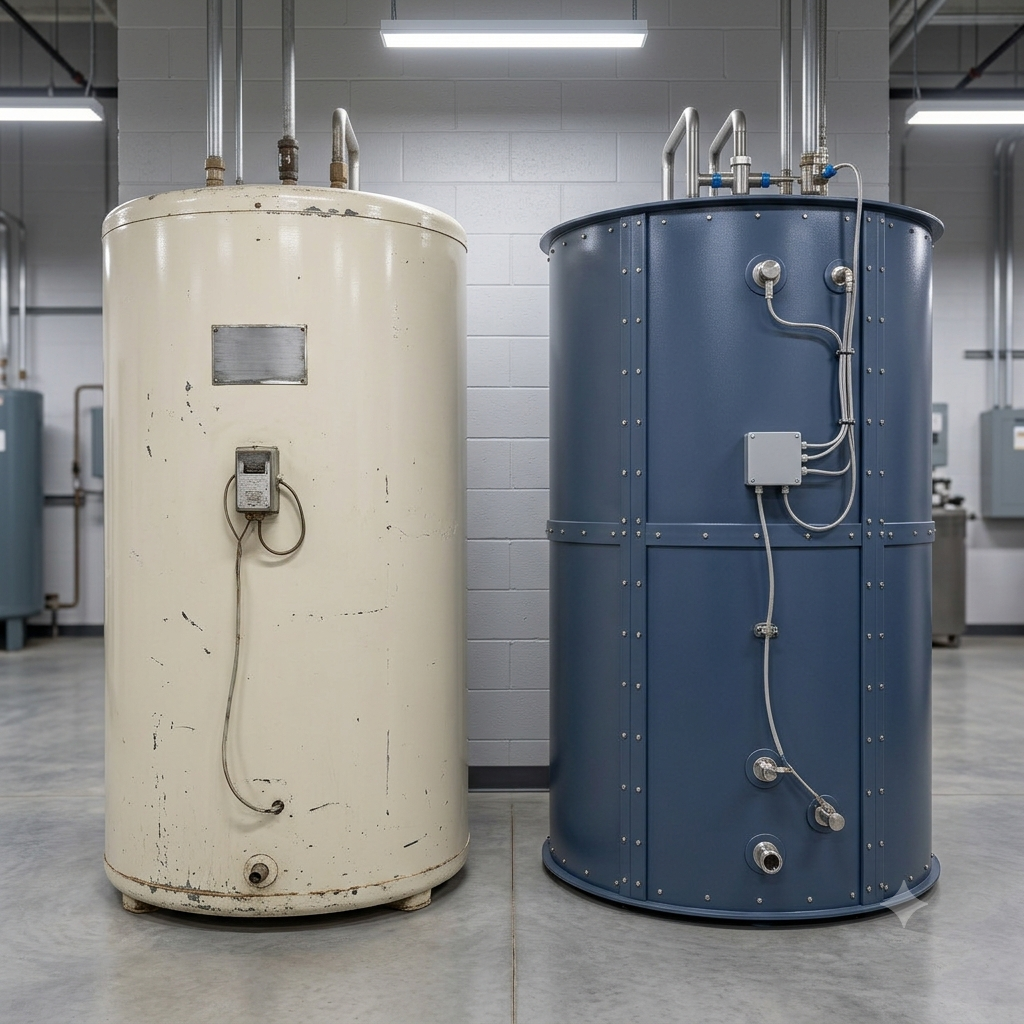
Here is the uncomfortable answer most vendors will not give you: a thermal battery and a conventional hot water storage tank can be the exact same physical object. There is no separate category of matter. Both hold hot water. Both store energy as sensible heat. The difference is not what the device is — it is whether the device was designed, insulated, and instrumented to be cycled.
A thermal battery is any device that stores thermal energy for later use, and a hot water storage tank is one of the oldest and cheapest examples. The meaningful distinction is functional, not categorical: a conventional storage tank is designed to hold hot water between draws, while a tank operating as a thermal battery is designed to be deliberately charged and discharged every day against a price signal or a plant-capacity constraint.
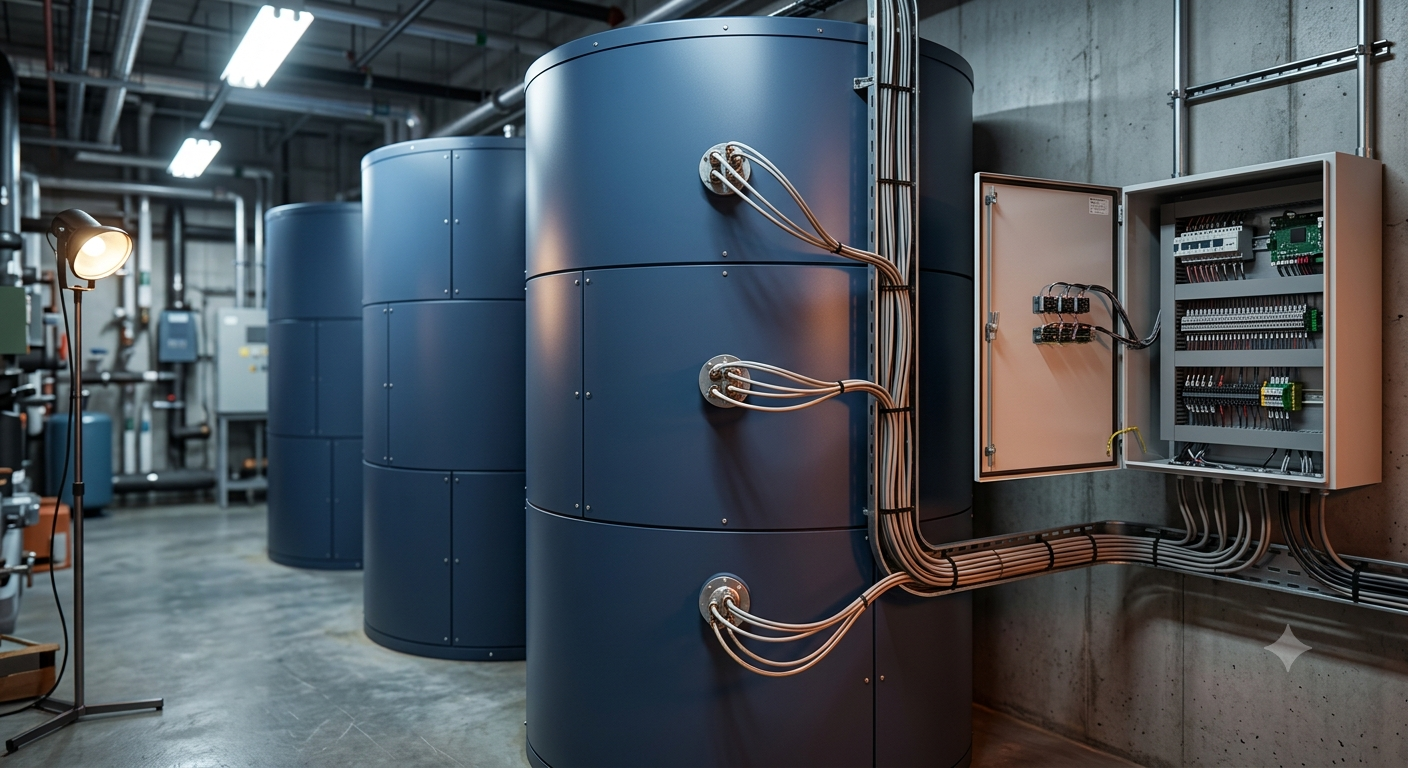
Doing that job well requires far better standing loss than the federal minimum, real stratification, multi-height temperature sensing so a controller can read state of charge, and a wide usable temperature delta. A tank that meets code and nothing more will physically work and will quietly lose the economics.
Key Takeaways
The useful question is never simply whether a tank is called a thermal battery. The useful question is how much of its stored energy remains after a sixteen-hour hold, whether the water stays stratified enough for the top of the tank to be worth drawing, and whether the control system can tell how much charge remains.
The comparison below separates the marketing term from the engineering specifications that determine whether a hot water tank can actually shift load.
In this article
What is a thermal battery?
A thermal battery is a device that stores energy as heat, or as the absence of heat, and releases it later. The term became popular because it is intuitive — if a battery is a device for storing energy, then a tank of hot water is a battery — and Lawrence Berkeley National Laboratory has used exactly that framing in describing why thermal energy storage deserves more attention as a grid resource.
Thermal storage divides into three families.
Three families of thermal storage
FamilyHow it stores energyTypical mediaPractical position
SensibleThe temperature of the medium rises; energy is proportional to mass, specific heat, and temperature change.Water, rock, sand, concrete, molten saltCheapest and most mature. Water has the highest specific heat of any common building medium.
LatentThe medium changes phase at a near-constant temperature; energy is absorbed as heat of fusion.Ice, paraffins, salt hydrates, food-grade PCMsHighest density per unit volume, but narrow useful temperature band and material-science baggage.
ThermochemicalA reversible chemical reaction stores and releases heat.Sorption pairs, hydration reactionsHighest theoretical density; still largely pre-commercial for buildings.
What is a conventional hot water storage tank — and what does code actually require?
A conventional unfired hot water storage tank is a vessel that holds water heated by external equipment. DOE defines it in 10 CFR 431.102. The design landscape is well established: welded steel, usually glass-lined for corrosion resistance, frequently built to ASME Section VIII pressure-vessel requirements, and insulated with foam under a painted steel jacket.
The federal efficiency requirement is a single number and it is old. Under 42 U.S.C. §6313, maximum heat loss for an unfired hot water storage tank is 6.5 Btu per hour per square foot of tank surface area — except that tanks over 140 gallons need not meet the standby loss requirement at all if the surface is insulated to R-12.5.
DOE codified the R-12.5 design requirement in a January 2001 final rule, and as the agency documented in its 2021 notice on unfired hot water storage tank standards, that remains the current federal standard.
Above 140 gallons — which is every tank in a commercial or multifamily central plant — a manufacturer can skip the standby loss test entirely by insulating to R-12.5. DOE has acknowledged in its own unfired hot water storage tank rulemaking FAQ that the magnitude of these standby losses is not well characterized. If you want to know how a specific tank performs on a sixteen-hour hold, the spec sheet is the only place to look, and many spec sheets do not report it.
The comparison, spec by spec
Nothing in the right-hand column is exotic. It is all ordinary engineering. But it is engineering that a commodity tank purchased on price per gallon will not have, and the deficiency does not show up until the controls contractor tries to write a charge schedule and discovers there is nowhere to put a sensor.
Conventional storage tank versus a tank engineered as a thermal battery
DimensionConventional storage tankTank engineered as a thermal battery
Design intentHold hot water between draws; buffer a burner or heat pump.Charge and discharge deliberately every day against price or plant capacity.
Duty cycleEffectively continuous hold; shallow, unplanned draws.One or more deep, scheduled cycles per day.
Insulation targetMeets R-12.5 federal minimum.Standing loss treated as a design specification, verified over the actual hold period.
StratificationOften incidental; mixed storage is acceptable.Engineered and preserved through vertical geometry, low-velocity inlets, and diffusers.
InstrumentationSingle aquastat or surface-mounted sensor.Thermowells at multiple heights so controls can compute state of charge.
Controls interfaceOn/off setpoint.Scheduled charge windows, demand ceilings, and tariff or utility-signal awareness.
Usable temperature deltaNarrow band around delivery temperature.Wide band; stored high and delivered low through a thermostatic mixing valve.
Capacity expansionReplace the vessel with a larger vessel.Add modules; capacity scales with load.
Installation pathWelded vessel, crane or rigging; doorway is a hard constraint.Panelized components carried in and assembled in the mechanical room.
How it is valuedA component of the water heating plant.An energy asset — potentially credit-eligible and potentially utility-program eligible.
Standing loss: the arithmetic nobody runs
Standing loss is usually dismissed as a small percentage. On a 700-gallon tank storing roughly 108 kWh, a few kWh per day of loss looks like noise. That framing is wrong.
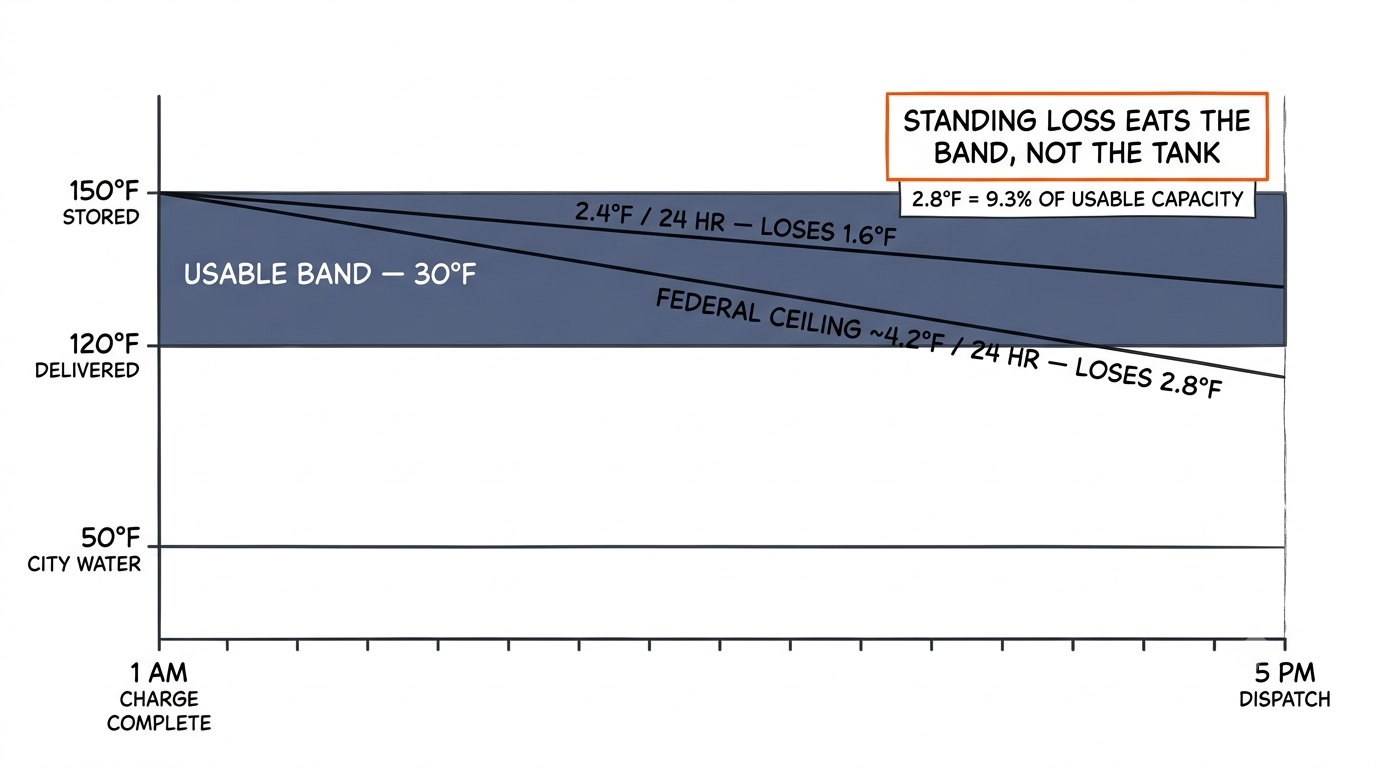
You do not get to use all 108 kWh. If the tank is charged to 150°F and the building is served at 120°F, the usable band is 30°F, not the full temperature range of the water. Standing loss does not eat a percentage of the tank — it eats a percentage of that band.
A 700-gallon vertical cylinder 60 inches in diameter and 88.6 inches tall has roughly 155 square feet of surface area. At the federal ceiling of 6.5 Btu/h per square foot, that is about 1,008 Btu/h, or about 24,200 Btu per day. Spread across 5,831 pounds of water, that is roughly 4.2°F of temperature drop per 24 hours — the worst a compliant tank is allowed to be. Thermal Energy HQ publishes 2.4°F per 24 hours for its 700-gallon module.
Charge at 1 a.m. and discharge into the 4–9 p.m. peak: that is a sixteen-hour hold.
Worked sixteen-hour standing-loss comparison
MeasureFederal ceiling tank, approximately 4.2°F per 24 hoursTEHQ 700-gallon, 2.4°F per 24 hours
Temperature lost over a 16-hour holdApproximately 2.8°FApproximately 1.6°F
As a share of a 30°F usable bandApproximately 9.3%Approximately 5.3%
Effect on dispatchable energyRoughly one hour of the evening peak evaporates before dispatch.Roughly half that.
Verify the measurement basis before quoting the comparison
The federal figure is a standby loss limit measured at a defined temperature differential between stored water and ambient. A manufacturer’s published °F-per-24-hour figure is only comparable if it was measured under the same conditions. The DOE standby loss procedure uses a 70°F differential between stored water and ambient.
Ask any vendor — including this one — for the ambient temperature, starting water temperature, and test method behind their standing loss number. A vendor who cannot answer has given you a marketing figure.
The second-order effect matters too: standing loss is driven by surface area, and surface-to-volume ratio falls as tanks get larger. That is visible directly in the published line — the 80-gallon module loses 7–8°F per 24 hours while the 700-gallon loses 2.4°F. Small tanks are disproportionately bad batteries, which is one reason distributed in-unit storage rarely shifts load well. Full dimensional data is in the thermal tank comparison and specifications, and the spec-selection logic is broken down further in What Is the Best Thermal Energy Tank? The 7 Specs That Actually Decide It.
Stratification and instrumentation: why a battery needs to know its own state of charge
A lithium-ion battery reports state of charge. A conventional hot water tank reports one temperature, usually from a single aquastat, and that number tells you almost nothing about how much dispatchable energy remains.
In a stratified tank, hot water floats above cold and the boundary between them — the thermocline — descends as the tank discharges. The position of that boundary is the state of charge. Read it with sensors at several heights and a controller can decide whether to run the heat pump now or ride through the peak. Read it with one sensor in the middle and the controller is guessing.
DOE’s Building America guidance on central heat pump water heater systems is explicit about the procurement consequence: controls typically rely on temperature sensors placed in thermowells at different heights in the storage tank, and the need for that measurement often requires custom specification when ordering tanks. The same guidance recommends vertical storage for single-pass systems specifically to maximize stratification.
Translated into a purchasing decision: thermowell count and placement are a line item. If they are not on the submittal, the tank cannot function as a battery no matter how well insulated it is, and retrofitting them into a pressure vessel later is not a small job.
The failure mode this produces
Phase change materials: where latent storage earns its premium, and where it does not
The strongest argument for a purpose-built “thermal battery” product is energy density. Latent heat storage packs more energy into less volume than water because the heat of fusion is absorbed at a nearly constant temperature rather than spread across a temperature rise. In a mechanical room where floor area is the binding constraint, that is a real argument.
The counterarguments are well documented in the peer-reviewed literature on phase change materials in hydronic heating and cooling systems. Sensible and latent storage both reduce the mismatch between generation and load, but short-duration sensible storage remains the best available technology for most building applications because of lower complexity and cost. The recurring material-science problems are supercooling, low thermal conductivity, phase segregation, and property degradation over extended cycling.
The honest summary: for domestic hot water and hydronic heating in the 120–160°F band, where delivery temperature is well matched to a wide sensible band and floor space can usually be found by going modular, water remains the right medium. PCM earns its premium where volume is genuinely fixed and the load sits tightly around one temperature. Anyone selling a PCM product should be asked for cycle-life test data and a supercooling mitigation strategy, in writing.
Water versus phase change material storage
DimensionWater, sensiblePhase change material, latent
Energy release profileGradual, across the full temperature band.Concentrated near the phase change temperature.
Density per unit volumeLower.Higher — the core advantage.
Useful temperature rangeWide and tunable by setpoint.Narrow and fixed by the material.
Heat transferExcellent; the medium is the working fluid.Limited by low conductivity; needs fins, encapsulation, or heat pipes.
Long-term stabilityEffectively indefinite; water does not degrade.Supercooling, segregation, and cycling degradation are active research problems.
Cost per stored kWhLowest of any building-scale medium.Materially higher.
ServiceabilityFill with standard water; no consumables.Proprietary medium; replacement is a vendor dependency.
Where thermal storage sits against electrochemical storage
A related question follows almost immediately: if a thermal battery is a battery, why not just buy a lithium-ion battery? The answer is that they address different loads, and the cost structures are not close.
Peer-reviewed work published through the DOE national laboratory system — “Addressing energy storage needs at lower cost via on-site thermal energy storage in buildings,” also available from Energy & Environmental Science — makes the structural case: buildings consume most of the world’s electricity, as much as half of that consumption serves thermal loads, and thermal energy storage can meet a large share of buildings’ storage requirement at a levelized cost that compares favorably with lithium-ion.
That is a claim about the share of the load that is thermal, not a claim that thermal storage replaces batteries. Electrical peaks from elevators, EV charging, refrigeration, and plug loads cannot be served by a hot water tank at any price. The division of labor is covered in more detail in Thermal Energy vs Solar Energy vs Lithium-Ion Storage, and the tariff mechanics that determine which strategy pays are covered in Peak Shaving vs Load Shifting.
On the incentive side, the distinction between “tank” and “battery” stops being semantic and becomes financial. The statutory definition of energy storage technology under 26 U.S.C. §48E expressly includes thermal energy storage, and the IRS Clean Electricity Investment Credit governs qualifying property placed in service after December 31, 2024. Whether a given installation qualifies depends on project facts, prevailing wage and apprenticeship compliance, and sourcing rules — confirm with a tax professional rather than a vendor.
What it costs
Vessel list pricing for modular sensible storage runs roughly $54–$97 per stored kWh depending on module size.
Modular sensible storage vessel pricing
ModelList price$/kWh stored$/gallonStorage capacity*Standing loss
80 gallon$1,190$97$14.8812.0 kWh7–8°F / 24 hr
350 gallon$3,427$63$9.7954.6 kWh3.8°F / 24 hr
500 gallon$4,464$58$8.9377.0 kWh3.0°F / 24 hr
700 gallon$5,798$54$8.28108.0 kWh2.4°F / 24 hr
Pricing boundary
*Rated at a 35°C temperature delta. Pricing is current as of August 2026; verify against the live thermal tank comparison and specifications before use in a proposal.
These are vessel prices, not installed system prices. A complete thermal storage system also requires the heat source, heat exchangers, piping, controls, seismic restraint, and labor. Any vendor comparison that puts a vessel price next to an installed battery price is comparing different cost boundaries. Ask every vendor for both numbers. Full cost breakdowns are in How Much Does a Thermal Energy Storage Tank Cost? A 2026 Price Guide and How Much Does Thermal Energy Storage Cost?.
When a conventional tank is the right answer
This article is published by a company that sells modular thermal storage, so it is worth being explicit about when the plain tank wins. It wins more often than the category’s marketing suggests.
When the battery framing genuinely applies
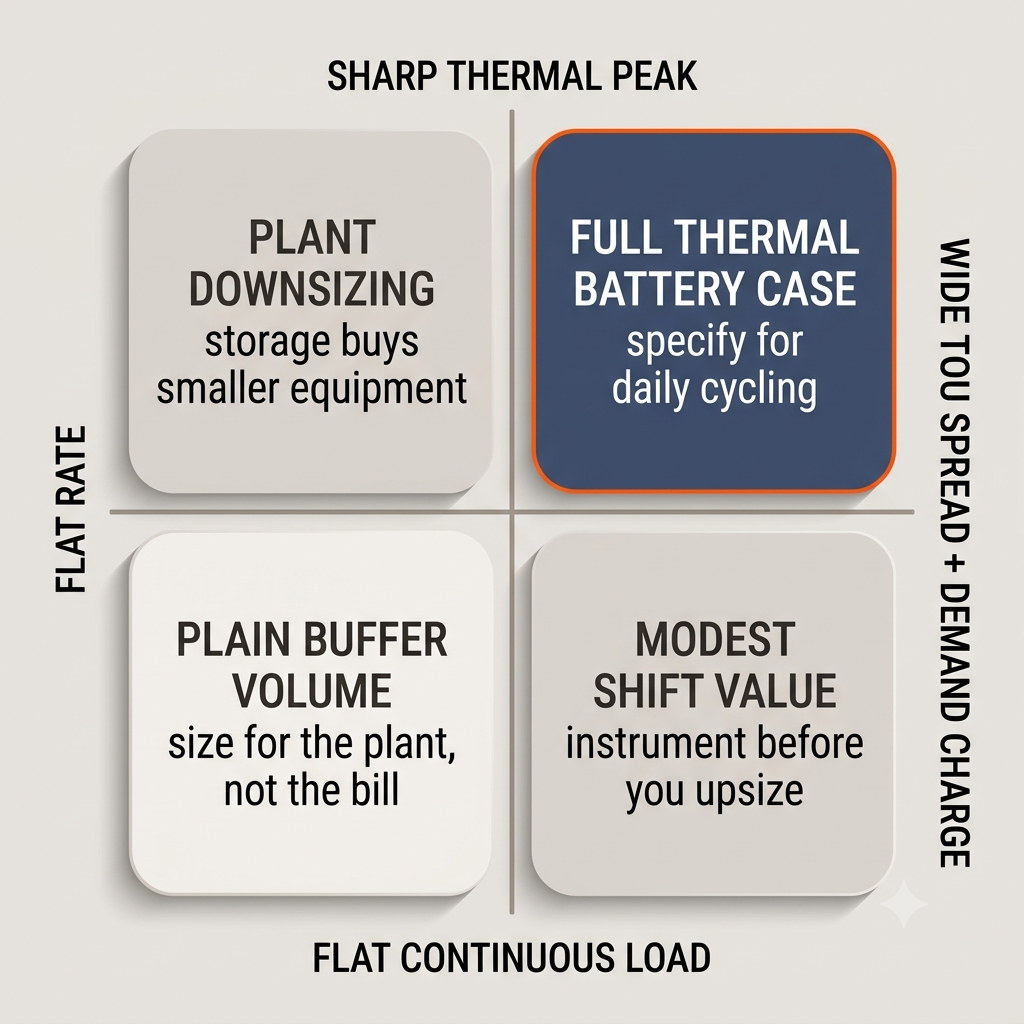
The battery framing genuinely applies where there are wide time-of-use spreads, meaningful demand charges or ratchets, a sharp thermal peak, on-site solar with poor export value, plant-capacity constraints that a smaller heat source would relieve, or an electrical service too small to support the peak-sized plant.
How to specify a tank that will actually work as a thermal battery
Use this procurement checklist during submittal review:
Sizing and system configuration
Sizing methodology for the volume itself is covered in the thermal storage tank sizing calculator, and payback structure in the thermal energy storage ROI calculator. For projects that prefer a coordinated assembly over field-built components, see the All-In-One thermal energy system.
The same object, two different jobs
Put a well-insulated, well-stratified, properly instrumented 700-gallon tank in a building with a flat rate and no controls, and it will behave as a conventional storage tank. Put a plain code-minimum tank in a building with a wide time-of-use spread and a good controller, and it will attempt to behave as a battery and underperform — losing a tenth of its usable band on every hold and never quite proving to the controller that it is charged.
The category does not decide the outcome. The specification does. That is why the useful question is never “should I buy a thermal battery or a hot water tank,” but “what is this tank being asked to do, and does its spec sheet support that job.” Real-world examples of how that resolves on built projects are in the case studies, and full specification sheets are in the technical documentation library.
Frequently Asked Questions
Is a hot water tank a thermal battery?
Functionally, yes. A hot water storage tank stores energy as sensible heat and releases it later, which is the definition of a thermal battery. The meaningful difference is not the category but the specification: a tank designed to be cycled daily needs far better standing loss than the federal minimum, engineered stratification, and temperature sensing at multiple heights so a controller can read state of charge. A tank that merely meets code will store energy but will not shift load well.
What is the difference between a thermal battery and a conventional hot water storage tank?
Design intent and instrumentation. A conventional storage tank is designed to hold hot water between draws and typically has a single aquastat. A tank engineered as a thermal battery is designed for deliberate daily charge and discharge against a price signal, with standing loss treated as a design specification, vertical geometry and diffusers to preserve stratification, thermowells at multiple heights, and a control sequence that defines charge windows and demand ceilings.
What insulation does code require on a hot water storage tank?
Under federal standards codified at 10 CFR 431.110, unfired hot water storage tanks must have a minimum thermal insulation of R-12.5. Maximum heat loss is 6.5 Btu per hour per square foot of tank surface area, but tanks over 140 gallons are exempt from the standby loss requirement if insulated to R-12.5. That standard has not been amended since 2001 and represents a floor, not a performance target for storage intended to be cycled.
Is a phase change material better than water for hot water storage?
Only when volume is the binding constraint. Phase change materials store more energy per unit volume because heat of fusion is absorbed near a constant temperature, but the peer-reviewed literature documents persistent problems with supercooling, low thermal conductivity, phase segregation, and degradation over extended cycling. For building hot water in the 120 to 160°F band, water remains lower cost per stored kilowatt hour, has a wider usable temperature range, transfers heat better, and does not degrade.
Why does standing loss matter more than it looks?
Because it consumes the usable temperature band, not the total stored energy. If a tank is charged to 150°F and delivers at 120°F, the usable band is 30°F. A tank losing about 4°F per 24 hours gives up roughly 2.8°F over a 16-hour hold, which is about 9 percent of that band, not 9 percent of the tank. Smaller tanks are disproportionately affected because standing loss scales with surface area while capacity scales with volume.
Does thermal energy storage qualify for the federal energy storage tax credit?
The statutory definition of energy storage technology under 26 U.S.C. Section 48E expressly includes thermal energy storage, and the clean electricity investment credit applies to qualifying property placed in service after December 31, 2024. Whether a specific installation qualifies depends on project facts, prevailing wage and apprenticeship compliance, and sourcing rules, so confirm with a tax professional.
Can I convert an existing hot water storage tank into a thermal battery?
Sometimes. Adding external insulation and a proper control sequence is often worthwhile on a serviceable tank. The harder constraints are instrumentation and porting: adding thermowells at multiple heights to an existing pressure vessel is not a minor modification, and a tank without dedicated heat source ports will blend water in ways that reduce heat pump efficiency. Assess the existing vessel before assuming either replacement or reuse.
Do I need a thermal battery or a buffer tank?
They solve different problems. A buffer tank provides hydraulic separation and prevents heat pump short cycling; it is sized from the heat source’s minimum run time. Storage sized as a thermal battery is sized from the load profile and the tariff. Some projects need both, and in some configurations one vessel can serve both roles if it is specified for the harder job.
Conclusion
There is no material difference between a thermal battery and a conventional hot water storage tank at the level of physics. Both store sensible heat in water. The difference lives entirely in the specification: how much heat is still there after a sixteen-hour hold, whether the water is stratified enough for the top of the tank to be worth drawing, and whether anything in the building can tell how much charge remains.
A tank that meets the federal R-12.5 floor and carries one aquastat is a legal, functional, perfectly reasonable storage tank. It is also a poor battery, and no amount of naming will change that. Conversely, a well-specified tank does not need to be called a battery to behave like one.
Ask for standing loss with test conditions, thermowell placement, dedicated heat-source ports, and a written control sequence. Those four items separate storage that shifts load from storage that merely occupies floor space.