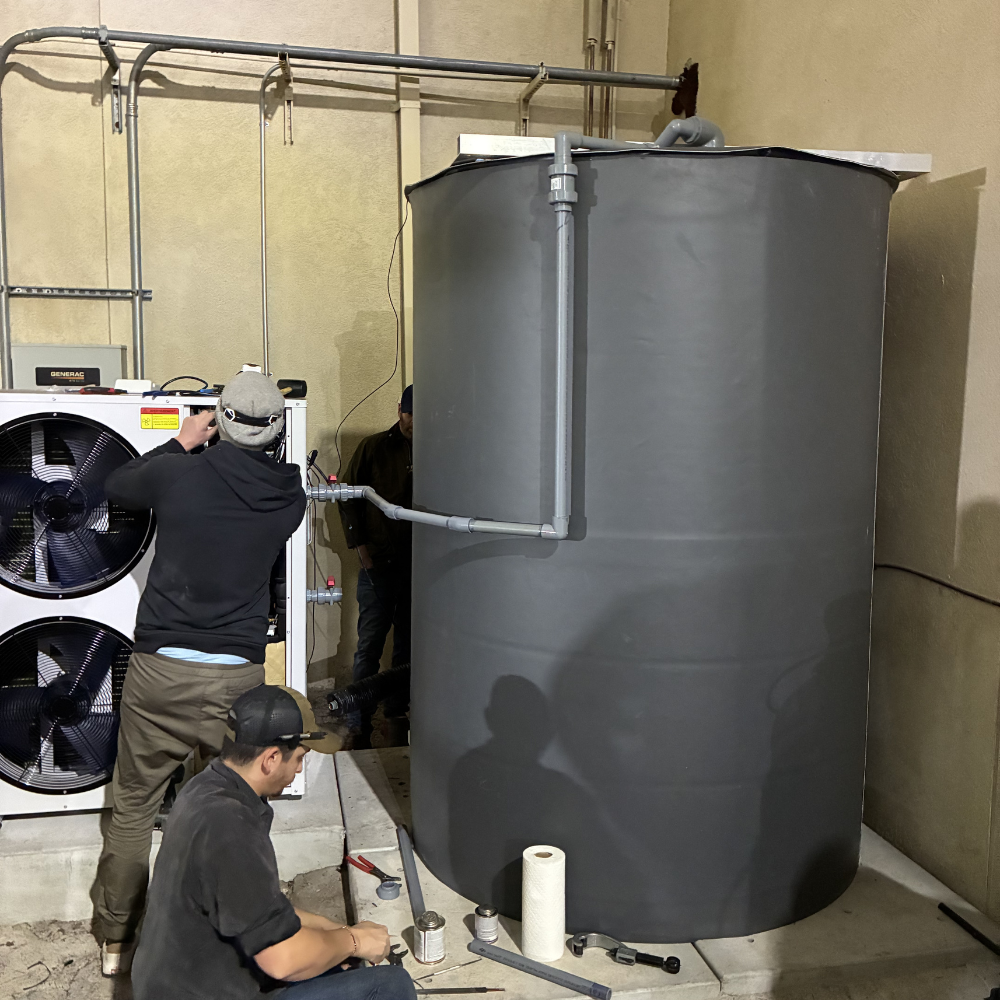
Two 700-gallon tanks at 140 F hold the same energy. Drawn at the same rate with the same 50 F make-up, one delivers 140 F water for most of its volume and the other starts cooling on the first gallon.
The difference is stratification: whether the tank keeps its hot water in a layer above the cold water, separated by a thin thermocline, or lets the two mix. For a heat pump water heater plant, where storage is the cheap component and heat pump capacity the expensive one, the stratified tank is the one the sizing calculation assumed. This article sets out why, what the published research says about the variables that control it, and what a designer specifies to keep the layer intact.
Key Takeaways
- Stratification is buoyancy: water at 140 F is less dense than water at 50 F, so the hot layer floats on the cold layer and the boundary, the thermocline, moves down as hot water is drawn and up as the tank is charged.
- Three variables control mixing in the Energies 2018 model study: inlet velocity, with the mixing coefficient following Z = 1.688 × 10^4 (Re/Ri)^0.67 and Re/Ri scaling with velocity cubed; aspect ratio, with 24 percent less mixing from 2.75 to 3.8 and 143 percent more from 3.8 to 1.0; and temperature difference, with 303 percent more mixing from an 80 C to a 10 C differential.
- Once a thermocline has formed it is tolerant: in the same study, raising inlet velocity from 0.9 to 2 cm per second widened the thermocline briefly and it then stabilized.
- The Energy Reports 2021 study of a double-coil vertical tank measured stratification numbers of 0.28 in charging and 0.32 in continuous delivery after 30 minutes, and found stratification improved when the upper coil was the one operating.
- The DOE Building America Solution Center guide for central heat pump water heaters states that storage stratification favors vertical tanks for single-pass systems and that horizontal tanks work with multi-pass units; swing tank configurations need primary storage at 150 F or greater.
- Idealized 700-gallon example at 140 F storage, 50 F make-up and 120 F minimum: fully mixed, about 176 gallons delivered above 120 F; perfectly stratified, 700 gallons at 140 F, about 900 gallons at 120 F after the mixing valve, roughly five times the usable volume.
- TEHQ modules are 60 inches in diameter at 49.6, 69.1 and 88.6 inches tall, aspect ratios of 0.83, 1.15 and 1.48; series piping across modules is how a modular bank behaves like one tall stratified tank.
Hot water is less dense than cold, so a tank fed cold at the bottom and hot at the top stratifies by itself unless something stirs it. The stirring comes from inlet momentum, which research measures with the ratio of Reynolds to Richardson number and which scales with the cube of inlet velocity.
Low aspect ratio also increases mixing. In one model study, mixing rose 143 percent as height-to-diameter fell from 3.8 to 1.0. Mixing rose 303 percent as the hot-cold differential fell from 80 C to 10 C.
Single-pass heat pump water heaters depend on a stratified tank because they draw cold water from the bottom and return hot water to the top in one pass. Multi-pass units tolerate a mixed tank because they raise the whole volume 5 to 10 F per pass.
On an idealized calculation, a perfectly mixed 700-gallon tank at 140 F delivers about 176 gallons above 120 F. A perfectly stratified one delivers 700 gallons at 140 F, or about 900 gallons at 120 F through a mixing valve. Real tanks sit between the two, and the design choices below decide where.
In this article
- What stratification is and what it is worth
- The three variables the research measures
- Why single-pass heat pump water heaters depend on the layer
- Design choices that preserve stratification
- What the TEHQ module geometry means for a bank
- A check sequence before the drawings are issued
- Frequently Asked Questions
- The bottom line
What stratification is and what it is worth
A storage tank is charged with hot water and discharged with cold make-up. If the hot water enters at the top at low velocity and the cold enters at the bottom at low velocity, the two layers stay separate because of their density difference, and a thin transition zone, the thermocline, sits between them. During a draw the thermocline moves down; the outlet at the top sees full storage temperature until the thermocline arrives. During charging the thermocline moves up. The tank's state of charge is the position of the thermocline, which is why a stratified tank needs several temperature sensors on a vertical line to report it; the thermal battery article covers the instrumentation.
A mixed tank behaves differently. Every gallon of 50 F make-up blends into the whole volume, so the outlet temperature falls continuously from the first draw. An idealized fully mixed tank follows an exponential: with T0 the starting temperature, Tin the make-up temperature and V the tank volume, the outlet temperature after drawing a volume Vd is Tin + (T0 − Tin) × exp(−Vd / V).
Setting T0 at 140 F, Tin at 50 F and a 120 F minimum gives exp(−Vd / V) = 70 / 90, so Vd = 0.25 V. A 700-gallon mixed tank delivers about 176 gallons above 120 F; after that the water is tepid and the remaining energy is stranded until the heater catches up.
The idealized stratified tank delivers all 700 gallons at 140 F. Through a mixing valve set at 120 F, each gallon of 140 F water blends with 50 F make-up in the ratio (140 − 120) / (120 − 50) = 20 / 70, so 700 gallons becomes 700 × 90 / 70 = 900 gallons at 120 F. The factor between the two cases is about five.
Real tanks have a thermocline with thickness, some inlet mixing and some conduction through the wall, so a well-designed tank delivers less than 900 and a poorly piped one more than 176; the design decides where in that range the tank lands, and the sizing calculator assumes the tank is near the top of it.
The three variables the research measures
Karim, Burnett and Fawzia modeled fully insulated water tanks at five aspect ratios, validated against earlier chilled-water experiments, and expressed mixing as a coefficient Z, with lower Z meaning less mixing. Their findings:
Kumar and Singh modeled a vertical domestic tank heated by two coils through charging, continuous delivery and discharge, validated against charging experiments, and reported a dimensionless stratification number of 0.28 after 30 minutes of charging and 0.32 in continuous delivery, with stratification improving when the upper coil was operating. The position of the heat input matters as much as the position of the inlets: heat added low in the tank drives a convection plume that mixes the column; heat added high leaves the cold layer undisturbed.
Bulnes, Rendall and Gluesenkamp at Oak Ridge compared a plug-flow model with a multi-node model of 6 to 96 nodes against measured heat-up of a tank driven by an external heat pump, including a layering process with eddy diffusivity five times the thermal diffusion rate. The relevance for a designer is that the standard simulation tools represent a tank as a stack of nodes with a thermocline between them, and a sizing result from such a tool assumes the real tank is piped so that the stack exists.
- Inlet velocity: mixing is governed by the ratio of Reynolds number to Richardson number, Z = 1.688 × 10^4 (Re/Ri)^0.67. Richardson number is g β ΔT h / v², so it rises as inlet velocity falls, and Re/Ri scales with v³. Halving the inlet velocity cuts the ratio by a factor of eight.
- Aspect ratio (height over diameter): going from 2.75 to 3.8 gave a 24 percent lower mixing coefficient at the same inlet velocity; going from 3.8 down to 1.0 increased mixing by 143 percent. The thinnest, steepest thermocline formed in the tallest tank. High-aspect-ratio tanks were less sensitive to velocity than low ones.
- Temperature difference: mixing increased by 303 percent as the hot-to-cold differential fell from 80 C to 10 C. The authors note that cooling systems are often limited to 10 to 20 C differentials, so heating storage, with its larger delta, stratifies more readily.
- Once formed, a thermocline tolerates more flow: raising the inlet velocity from 0.9 to 2 cm per second widened it briefly and it then stabilized. The authors did not study diffusers or port placement and say so.
Why single-pass heat pump water heaters depend on the layer
A single-pass heat pump draws cold water from the bottom of the tank, heats it to the storage setpoint in one pass and returns it to the top. Its efficiency comes from the cold inlet: the refrigerant rejects heat across the full lift from 50 F to the setpoint. If the tank is mixed, the heat pump sees tepid water at its inlet, its capacity and COP fall, and it may not reach setpoint at all.
The DOE Building America Solution Center guide states the consequence directly: storage stratification favors vertical tanks for single-pass systems, while horizontal tanks work with multi-pass units, which raise the whole volume 5 to 10 F per pass into a mixed-temperature tank the way a gas water heater does. The single-pass versus multi-pass article sets out the equipment side.
The same guide explains why the tank is sized the way it is: storage is far cheaper than heat pump capacity, so central plants use large storage to meet peaks and run the heat pumps up to 16 to 20 hours per day to recharge it. A stratified tank is what makes that work, because it delivers setpoint water through the morning peak while the heat pump is still working its way up the column. The guide also notes the swing tank configuration, where the recirculation return passes through a tank in series with primary storage, needs primary storage at 150 F or greater; the swing tank sizing article covers that design.
Where the recirculation loop returns decides a great deal. Return water at 115 to 125 F sent into the bottom of primary storage is the largest routine source of mixing in a central plant and the reason the guide describes the parallel loop tank and swing tank alternatives; the recirculation versus storage article covers the trade.
Design choices that preserve stratification
- Aspect ratio first, then compensate. A single tall tank stratifies best. Where ceiling height, door width or floor loading rule out a tall vessel, pipe several shorter modules in series so the bank behaves as one tall column; the series versus parallel article sets out the piping. Parallel modules each see the full inlet flow divided by the number of tanks, which lowers velocity, but they stratify only as well as the shortest of them.
- Low inlet velocity. The cubic relationship means the inlet port is the lever: a larger port, a diffuser or a radial inlet plate that spreads the incoming cold water horizontally across the bottom keeps Re/Ri low. The research says a formed thermocline tolerates a velocity increase, so the critical period is the first minutes of a draw after a full charge.
- Large delta. Storing at 140 F against 50 F make-up gives a 90 F (50 C) differential; the 140 F storage article covers the Legionella and mixing valve side of that choice. Storage at 120 F against 50 F make-up halves the differential and, on the published trend, raises mixing substantially.
- Heat input high or external. An immersed coil low in the tank drives a plume; an external heat exchanger that returns hot water to the top, or an upper coil, leaves the cold layer alone, which is what the Energy Reports study measured.
- Keep tepid returns out of the bottom. Route recirculation return to a swing tank or a dedicated temperature maintenance tank rather than the base of primary storage.
- Insulate. Conduction through the tank wall and the tank floor slowly erodes the thermocline from the outside; the heat loss article gives the method.
What the TEHQ module geometry means for a bank
The TEHQ Thermal Tank modules are 60 inches in diameter at three heights: 49.6 inches for 350 gallons, 69.1 inches for 500 gallons and 88.6 inches for 700 gallons, giving aspect ratios of 0.83, 1.15 and 1.48. The specification sheet lists stored energy of 54.6, 77.0 and 108.0 kWh thermal at a 35 C (63 F) delta and heat loss under free convection of 3.8, 3.0 and 2.4 F per 24 hours respectively, the larger module losing least per gallon because surface area grows more slowly than volume. The lid assembly carries the heat exchanger ports, 2.375 inch and 1.375 inch, through which the primary and secondary circuits are connected.
Those ratios are low by the standard of the research tanks, which is the trade for a vessel that fits through a door and assembles in the room. The compensation is in the piping: a bank of 700-gallon modules in series presents a column 88.6 inches tall per module to the flow, and the cold make-up enters only the last module in the chain, so the thermocline forms in one module at a time. The series versus parallel article gives the arrangement, and the existing buildings article covers placing the bank where the floor loading of 308 lb per square foot filled allows it.
For a 700-gallon module the idealized mixed-versus-stratified figures above, 176 against 900 gallons at 120 F, are the range the piping decides.
A check sequence before the drawings are issued
- Confirm the heat pump type: single-pass requires a stratified, vertical arrangement with cold draw from the bottom and hot return to the top; multi-pass tolerates mixing.
- Set the storage temperature and the make-up temperature, and record the differential; the smaller it is, the closer the tank behaves to the mixed case on the published trend.
- Size the inlet connection and diffuser for the peak draw rate so that the inlet velocity stays as low as the port allows; the sheet gives port sizes, the manufacturer gives flow limits.
- Pipe multiple modules in series unless pressure drop or redundancy requires parallel, and if parallel, balance the flow.
- Route recirculation return to a swing or maintenance tank, not the base of primary storage.
- Place at least three temperature sensors on a vertical line to track the thermocline and set the heat pump control on the lowest one.
- Run the sizing calculator with the usable fraction the arrangement supports, not the rated capacity.
Frequently Asked Questions
What is thermal stratification in a hot water storage tank?
The separation of hot water above cold water in the same tank, caused by their density difference, with a thin transition layer called the thermocline between them. A stratified tank delivers water at storage temperature until the thermocline reaches the outlet.
How much more hot water does a stratified tank deliver than a mixed one?
On an idealized calculation at 140 F storage, 50 F make-up and a 120 F minimum, a fully mixed 700-gallon tank delivers about 176 gallons above 120 F, and a perfectly stratified one delivers 700 gallons at 140 F, about 900 gallons at 120 F through a mixing valve. Real tanks fall between the two.
Does tank aspect ratio matter?
Yes. In the Energies 2018 model study, mixing fell 24 percent as height-to-diameter rose from 2.75 to 3.8 and rose 143 percent as it fell from 3.8 to 1.0. Short modules are piped in series to behave as one tall tank.
Why does inlet velocity matter so much?
Mixing scales with the ratio of Reynolds to Richardson number, and that ratio scales with the cube of inlet velocity, so halving the velocity cuts the driver of mixing by about eight times. A larger port or a diffuser is the lever.
Do single-pass heat pump water heaters need a stratified tank?
Yes. They draw cold water from the bottom and return setpoint water to the top in one pass; a mixed tank raises their inlet temperature and lowers capacity and COP. The DOE Building America Solution Center guide favors vertical tanks for single-pass systems and says horizontal tanks work with multi-pass units.
Does a higher storage temperature help stratification?
Yes. Mixing in the model study increased 303 percent as the hot-to-cold differential fell from 80 C to 10 C, so a larger differential stratifies more readily; the setpoint choice also carries Legionella and mixing valve implications covered in the 140 F article.
Where should the recirculation return go?
Not into the base of primary storage. Tepid return water at 115 to 125 F mixes the column; a swing tank in series or a dedicated temperature maintenance tank keeps the primary tank stratified.
The bottom line
A storage tank is only as large as its stratification lets it be. The physics is buoyancy, the enemies are inlet momentum, low aspect ratio, small temperature difference and tepid returns, and the research puts numbers on each: velocity cubed, 143 percent more mixing at an aspect ratio of 1.0, and 303 percent more at a 10 C differential.
On an idealized calculation the difference between a mixed and a stratified 700-gallon tank is 176 gallons against 900 gallons of 120 F water. Pipe short modules in series, keep the inlet slow, store hot against cold make-up, send recirculation return to a swing tank, and the tank the sizing calculator assumed is the tank the building gets.