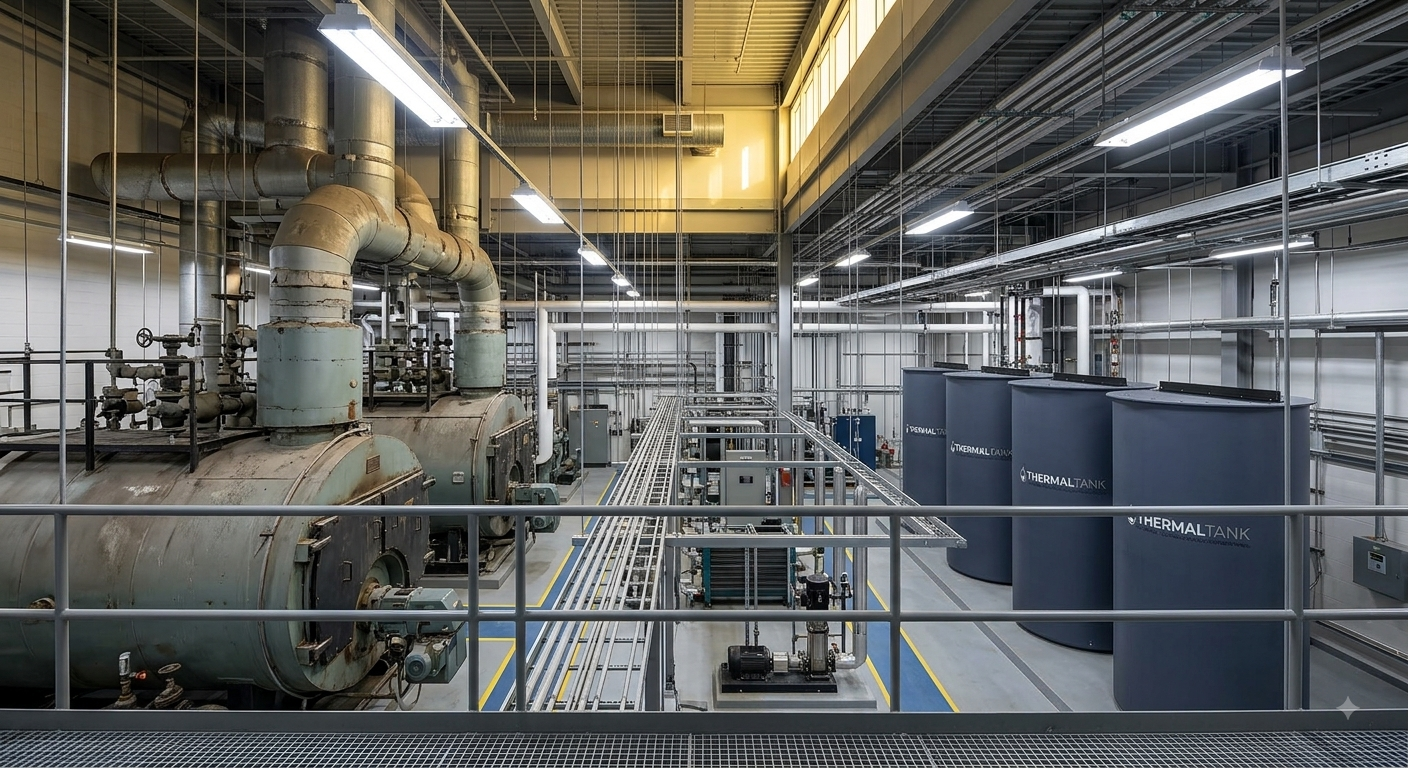
Every building considering electrification worries about reliability. In a hospital the worry is different in kind, not degree. Service hot water reaches surgical scrub sinks, sterile processing, dialysis support, patient bathing, dietary, and laundry — and the people downstream of it include some of the most vulnerable in the building. There is no acceptable outage window, no season when the plant can be taken down, and no version of “we will tune it after commissioning” that survives contact with an accreditation survey.
In short: Hospitals electrify service hot water slowly and in phases, and thermal storage is one of the tools that makes a phased conversion survivable. Storage lets a smaller heat pump plant meet a peak it could not meet directly, holds charged capacity while a heat source is down or being serviced, decouples heat recovery availability from clinical demand, and shortens the period during which legacy boilers must be maintained in parallel. It does not replace code-required redundancy, emergency power, or any life-safety system, and no vendor should tell you otherwise. The design work that is genuinely hospital-specific is the conflict between pathogen-control storage temperature and anti-scald delivery limits, the water management program that governs both, and the fact that construction happens around live patient care.
Key Takeaways
Hospitals electrify service hot water slowly, in phases, with the old plant running alongside the new one until the new one has proven itself. The temperature, water-management, electrical, and construction constraints make a straight equipment swap inappropriate for this risk environment.
Thermal storage can help bridge that conversion. It provides stored capacity, allows a smaller heat pump plant to cover peaks, and creates time for maintenance or fault response. But it remains a continuity tool, not a substitute for any code-required system.
In this article
Why hospital hot water is a different risk class
Three things separate a hospital service hot water system from every other commercial building in this series.
First, it is federally regulated as a patient safety matter. CMS memorandum QSO-17-30 directs hospitals, critical access hospitals, and long-term care facilities participating in Medicare and Medicaid to develop and adhere to policies and procedures that reduce the risk of Legionella and other opportunistic waterborne pathogens. Facilities are expected to conduct a facility-specific risk assessment, implement a water management program that considers ASHRAE Standard 188 and the CDC water management toolkit, specify control measures and acceptable ranges, and document corrective actions when those ranges are not met. Surveyors review that documentation.
Two things that memorandum does not do are worth stating plainly, because vendors routinely overstate them: it does not prescribe a specific storage temperature, and it explicitly leaves environmental testing protocols to the facility. What it requires is a documented, implemented program — and any change to the hot water plant is a change to that program.
Second, the population is unusually vulnerable at both ends of the temperature range. Immunocompromised patients face elevated risk from waterborne pathogens; patients with thin or compromised skin, reduced sensation, or limited mobility face elevated scald risk. The design has to serve both.
Third, the building never stops. There is no summer break, no low-occupancy week, and no tolerance for an unplanned interruption in a department that cannot defer its work.
The temperature conflict at the centre of the design
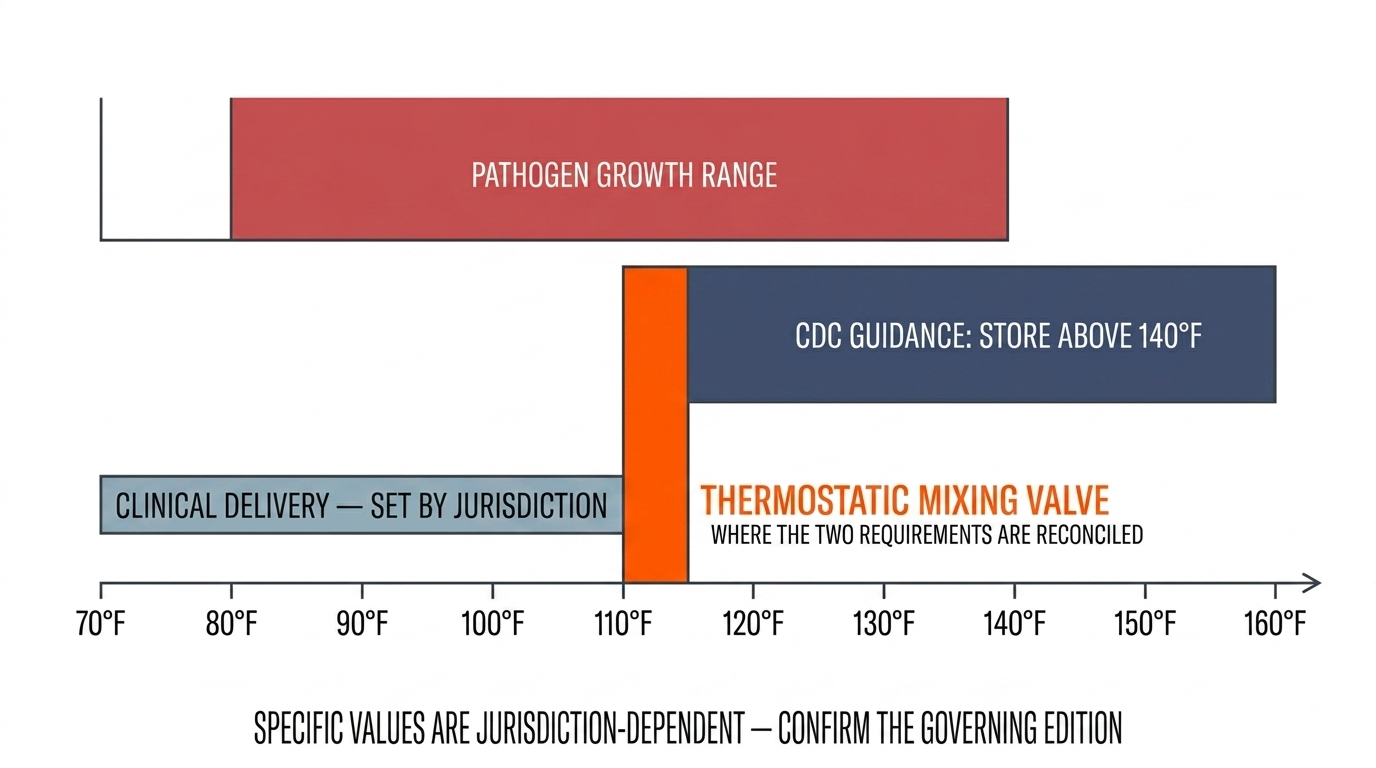
Every hospital service hot water design reconciles two requirements that pull in opposite directions.
The reconciliation is the thermostatic mixing valve, and in a hospital it deserves to be treated as a primary design element rather than a fitting. It is what makes high-temperature storage compatible with low-temperature clinical delivery, and it is what converts stored energy into delivered gallons. Size it for peak instantaneous flow at design conditions, specify its failure behaviour, and confirm its inlet piping does not allow recirculation return to blend with cold make-up.
Specific temperature figures are jurisdiction-dependent and should not be taken from an article. The FGI Guidelines for Design and Construction set clinical hot water ranges that many authorities having jurisdiction adopt, but adoption is not universal, editions differ, and some states — California among them — regulate through their own code amendments instead. Establish the governing document and edition for your facility before any number goes on a drawing.
Competing design pressures in hospital service hot water
PressureDirectionWhy
Pathogen controlStore hotterCDC guidance for potable water systems directs storing hot water above 140°F and keeping circulating hot water above 120°F, because the growth range sits below those thresholds.
Anti-scald and patient safetyDeliver coolerClinical hand hygiene and patient bathing fixtures are limited well below storage temperature; vulnerable skin burns faster at a given temperature.
Usable capacityStore hotterThe wider the band between storage and delivery, the more service hot water each stored gallon produces.
Heat pump efficiencyStore coolerHigher condensing temperature means lower coefficient of performance and, for some equipment, reduced capacity.
A finding that complicates the simple version
The ASHE-funded feasibility study at Providence St. Peter Hospital reports that the hospital’s service hot water system operates at 120°F rather than the 140°F more commonly associated with CDC guidance, that this simplified serving service hot water from the heating hot water loop, and that no Legionella concerns had arisen at the lower temperature.
That is a real, published, single-facility observation and it is worth knowing. It is not a design recommendation and it does not generalise: it reflects one building’s water system, water chemistry, distribution, usage pattern, and water management program. The reason to report it is that the honest version of this topic is more complicated than “store at 140°F and you are compliant.” What CMS requires is a documented program with defined control measures and corrective actions — and temperature is one control measure among several.
What reliability actually means in this building
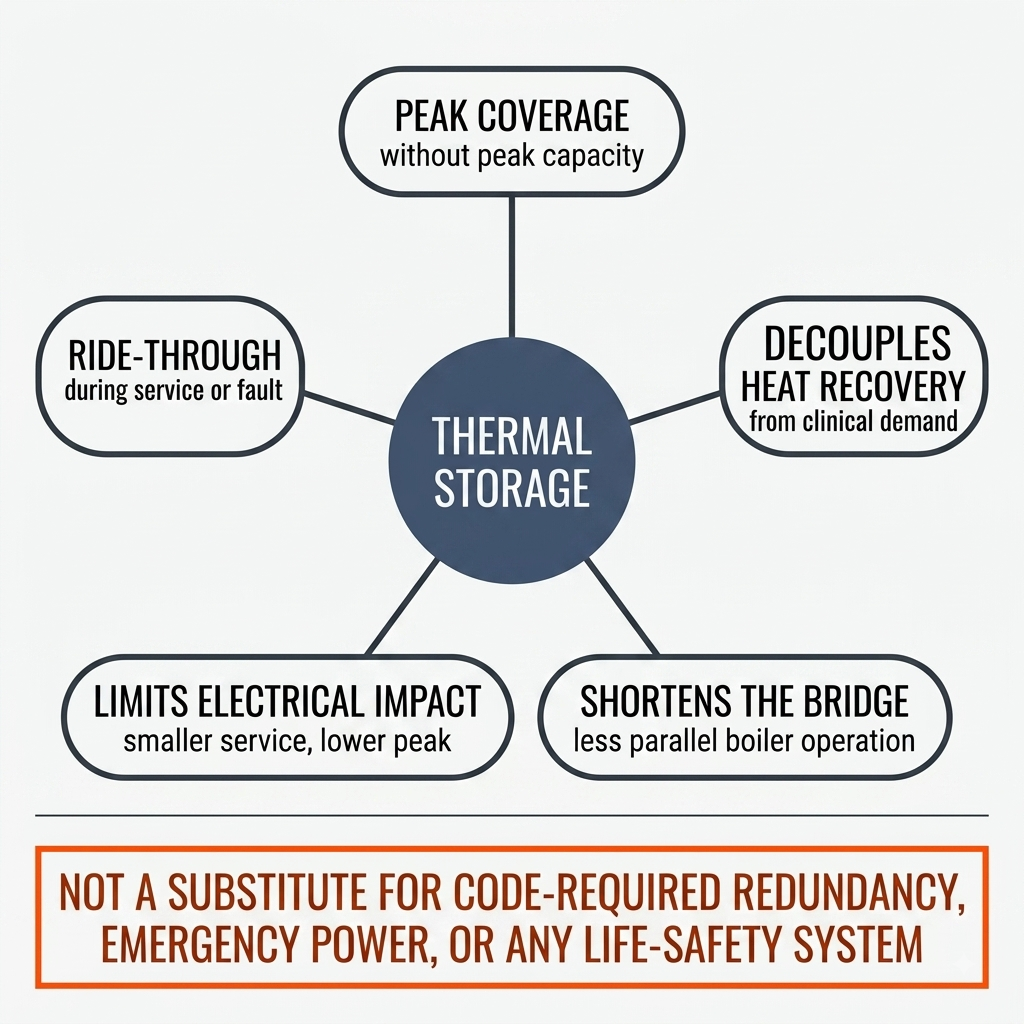
“Reliable” in a hospital has a specific, codified meaning, and it is important to separate what codes require from what thermal storage contributes.
Stated plainly, because vendors blur this: Thermal storage does not satisfy, substitute for, or reduce any code-required redundancy, emergency power, essential electrical system, or life-safety requirement. NFPA 99, NFPA 110, and NEC Article 517 obligations are unchanged by the presence of a storage tank. Whether service hot water equipment is served from the essential electrical system, and on which branch, is a determination for the design team and the authority having jurisdiction — not something a storage vendor can answer.
What storage does is different and still valuable: it is stored capacity that continues to serve the building when a heat source is unavailable. That extends the window in which a fault is invisible to clinical operations. It is a continuity contribution, not a compliance one.
With that boundary drawn, the reliability contributions are concrete:
Five reliability contributions of thermal storage
RoleWhat it doesWhy it matters in a hospital
Peak coverage without peak capacityA charged tank meets a demand spike a smaller plant could not meet directly.Allows the heat pump plant to be sized realistically rather than to an unaffordable peak.
Ride-through during service or faultStored energy continues to serve while a heat source is down or being maintained.Planned maintenance stops requiring a departmental workaround.
Decoupling heat recovery from demandRecovered heat is available when the cooling load allows, not when clinical demand occurs.Makes heat recovery from chiller plants usable rather than theoretical.
Shortening the parallel-plant periodA capable storage-backed plant reaches operational proficiency sooner.Reduces how long legacy boilers must be maintained, staffed, and fuelled in parallel.
Limiting electrical impactA smaller plant running longer draws less peak power than one sized to the instantaneous peak.Directly affects service capacity, generator sizing conversations, and demand charges.
What one hospital’s own feasibility study concluded
The most useful public document in this space is not a vendor white paper. The American Society for Health Care Engineering funded a decarbonisation feasibility case study at Providence St. Peter Hospital in Olympia, Washington — a 733,000 square foot, 372-bed community hospital whose first phase was built in 1969 — and published the foreword and executive summary through the American Hospital Association.
Read the caveat first. ASHE states in the foreword that the publication is not intended as a playbook for electrifying any given hospital, nor as a benchmark by which other hospitals pursuing this goal should be measured, and that the path to complete electrification is an extremely complex and bespoke process. Everything below should be read as one building’s answer, not the answer.
With that stated, four findings are directly relevant to how storage is used:
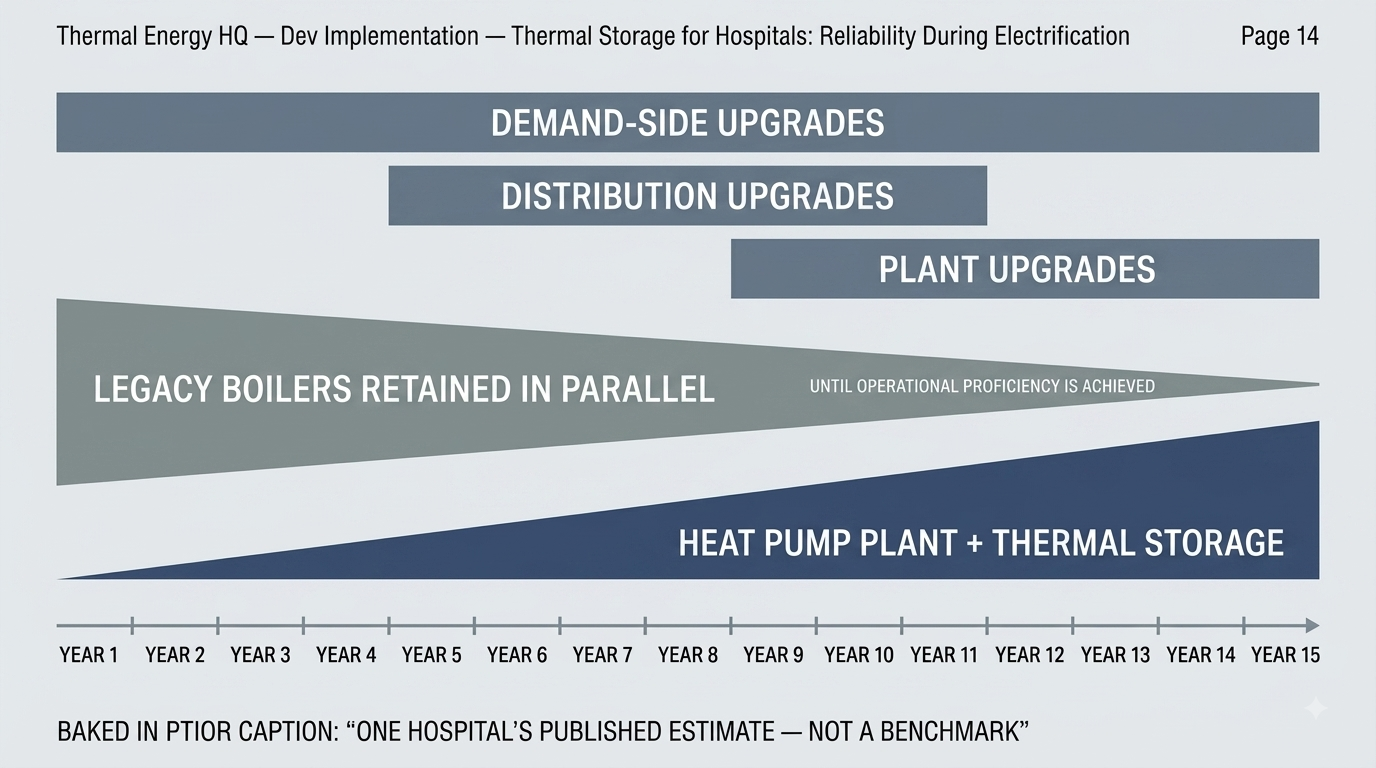
It is technically feasible, and it takes 10 to 15 years. The study attributes the timeline to the nature of the hospital as a patient care environment and the need for normal operations — and concludes that this demonstrates the need for careful planning and early preparation.
The recommended plant strategy includes very large storage. After demand-side and distribution upgrades, the heating plant is upgraded with air-source heat pumps as the primary thermal source, augmented with a heat recovery chiller and 100,000 gallons of heating hot water storage. The phasing also contemplates installing thermal storage or a microgrid in the vacated boiler footprints.
Demand-side work comes first and dominates the schedule. The recommended phasing puts nine years of demand-side upgrades ahead of one to two years of distribution work and three to five years of plant work. Measured peak heating load of 20 MMBtu/hr is projected to fall to 11 MMBtu/hr if all demand-side measures are implemented — roughly a 45% reduction before a single heat pump is selected.
The boilers stay until the new plant proves itself. The published resilience strategy retains on-site fuel storage and existing boilers until operational proficiency is achieved with the heat pump plant and generator heat recovery, with thermal storage and microgrids to be reevaluated as replacements for the boilers as the technology matures.
That fourth point is the one worth sitting with. A hospital that has done a year of engineering analysis, with a real budget and real consultants, concluded that it would keep the old plant running in parallel until the new one had earned trust. Any vendor proposing a hospital hot water conversion as a clean equipment swap should be asked why their plan is more confident than that one.
The financial framing is equally sobering and equally useful: full electrification of the thermal load was estimated at roughly $100 per square foot in capital expenditure, and the study’s 17-year total cost of ownership modelling found the most cost-effective fully electrified scenario still materially more expensive than business as usual before utility rate escalation and incentives are considered. That is not an argument against electrification — regulatory drivers and system climate commitments exist regardless — but it is a reason to sequence carefully and to prefer measures that reduce load before measures that replace equipment.
Sizing storage for a hospital: what is different
The underlying method is the same as any central plant — establish the load, add distribution losses, size at design conditions, choose a point on the capacity-versus-storage curve. Four things change in a hospital.
The load is more diverse and less peaky than multifamily or hospitality. Patient bathing, clinical hand hygiene, dietary, sterile processing, and laundry run on different schedules, which flattens the aggregate profile. That is generally favourable for a heat pump plant, but it means a shower-peak sizing method borrowed from another building type will misrepresent it.
Continuity capacity is a deliberate line item. Beyond the volume sized for peak coverage, the design team may choose to carry additional stored energy specifically to ride through a heat source outage or a maintenance window. Size that consciously, document the assumed duration, and do not conflate it with code redundancy.
Standing loss matters over the hold period that actually applies. A tank charged overnight and held into an afternoon peak has held its charge for many hours, and standing loss consumes the usable band between storage and delivery temperature rather than a percentage of tank volume. Specification detail is in What Is the Best Thermal Energy Tank? The 7 Specs That Actually Decide It.
Instrumentation is not optional. A plant that cannot report state of charge cannot be trusted to dispatch, and in a facility with a documented water management program the temperature record is part of the compliance evidence. Multi-height tank sensing should be on the submittal, not discovered later.
Volume methodology is in the thermal storage tank sizing calculator, the buffer-versus-storage distinction in Buffer Tank vs Storage Tank: Do You Need a Buffer Tank for a Heat Pump?, and the failure modes that recur across storage projects in Common Design Mistakes in Commercial Thermal Energy Storage Projects.
Heat sources and heat recovery in a hospital
Hospitals are among the strongest heat recovery candidates in commercial building stock, because they reject heat and buy heat simultaneously for most of the year: chiller plants serving imaging, data rooms, sterile processing, and high outside-air ventilation run while service hot water demand continues. The Providence St. Peter strategy pairs air-source heat pumps with a heat recovery chiller for exactly this reason.
Storage is what makes the recovery usable. Recovered heat becomes available on the cooling plant’s schedule, not on the clinical schedule, and without a tank between them the two rarely coincide. Load coincidence analysis is covered in Heat Recovery Chillers vs Thermal Energy Storage: Why Load Coincidence Decides.
One further note from the same case study, relevant to anyone assuming service hot water must be its own plant: at that facility, a 120°F service hot water setpoint made it practical to serve service hot water from the heating hot water loop rather than running a warmer loop or installing a standalone heat pump system. Whether that architecture is available to a given hospital depends entirely on its own temperature requirements and water management program.
Building it around live patient care
Everything above is engineering. This is where hospital projects actually differ from every other vertical, and it belongs in the bid documents rather than in a change order.
Occupied-hospital construction constraints
ConstraintWhat it means in practice
Infection control risk assessmentConstruction adjacent to patient care areas is governed by an ICRA. Containment, negative pressure, and pathway control are scope items with schedule and cost implications.
Interim life safety measuresWork affecting egress, alarm, or suppression triggers documented interim measures for the duration.
No shutdown windowEvery tie-in is a live tie-in. Identify each moment the building depends on a single source and shorten it deliberately.
Water management program risk updatesAny change to the hot water system is a change to the documented program — risk assessment, control measures, and corrective actions all need revisiting.
Flushing and recommissioningNew or modified piping introduces stagnation and disturbance risk; the water management team should be involved before, during, and after.
Departmental coordinationSterile processing, dietary, dialysis support, and laundry each have windows that cannot move. The schedule is negotiated, not published.
Access and phasing
The mechanical room access problem is also more acute here than elsewhere: hospital central utility plants are frequently below grade, congested with decades of accumulated infrastructure, and reachable only through corridors that carry clinical traffic. Where a delivery path will not admit a welded vessel, panelized tanks that assemble inside the room are the standard workaround — covered in Designing Thermal Storage for Existing Buildings Without Major Mechanical Room Expansion. Broader phasing strategy for occupied buildings is in How to Electrify Domestic Hot Water in Existing Multifamily Buildings; the sequencing logic transfers even though the regulatory context does not.
The electrical service question
A hospital adding electric thermal capacity is adding load to a distribution system that already carries life-safety obligations, and the conversation is more complex than in other buildings.
Tariff mechanics
Tariff mechanics, including whether shaving a thermal load actually reduces a demand charge, are covered in Peak Shaving vs Load Shifting.
Cost and incentives
Storage is a small line relative to a hospital central plant conversion — the Providence St. Peter study put full thermal electrification at roughly $100 per square foot across a 733,000 square foot facility — which is precisely why trading storage volume for a smaller heat pump plant and a smaller electrical scope so often improves the overall number.
Pricing is current as of August 2026; verify against the live thermal tank comparison and specifications. Vessel prices, not installed system prices — and in a hospital the general conditions, infection control measures, and phased live tie-ins are a substantial share of installed cost. Full cost structure is in How Much Does Thermal Energy Storage Cost?, and packaged assemblies that reduce on-site work are in the All-In-One thermal energy system.
On the federal side, the statutory definition of energy storage technology under 26 U.S.C. §48E expressly includes thermal energy storage, and the IRS Clean Electricity Investment Credit governs qualifying property placed in service after December 31, 2024. Tax-exempt health systems should note that elective payment provisions may apply differently than to taxable entities — confirm with tax counsel, not with a vendor. Utility custom programs paying on measured demand reduction are also common in this sector; program managers can start at the Thermal Energy HQ utilities and programs page.
Illustrative thermal tank vessel pricing and performance
ModelList price$/kWh storedStorage capacity*Standing loss
80 gallon$1,190$9712.0 kWh7–8°F / 24 hr
350 gallon$3,427$6354.6 kWh3.8°F / 24 hr
500 gallon$4,464$5877.0 kWh3.0°F / 24 hr
700 gallon$5,798$54108.0 kWh2.4°F / 24 hr
A readiness checklist
Use these questions to establish whether a hospital is ready to plan a phased service hot water electrification.
The question that determines the real cost
Question 9 is the one that determines the real cost of the project, because parallel plant operation is expensive in staff time, fuel contracts, maintenance, and floor area. Anything that shortens it — including storage that lets the new plant carry more of the load sooner — is worth more than its line item suggests. Examples of built projects are in the case studies, with specification sheets in the technical documentation library.
Frequently Asked Questions
Does thermal storage satisfy hospital redundancy or emergency power requirements?
No. Thermal storage does not satisfy, substitute for, or reduce any code-required redundancy, emergency power, essential electrical system, or life-safety requirement. Obligations under NFPA 99, NFPA 110, and NEC Article 517 are unchanged by installing storage. What storage provides is stored capacity that continues to serve the building while a heat source is unavailable, which extends the window in which a fault remains invisible to clinical operations. That is a continuity contribution, not a compliance one.
What does CMS require hospitals to do about hot water and Legionella?
CMS memorandum QSO-17-30 directs hospitals, critical access hospitals, and long-term care facilities participating in Medicare and Medicaid to develop and adhere to policies and procedures reducing the risk of Legionella and other opportunistic waterborne pathogens. Facilities are expected to conduct a facility-specific risk assessment, implement a water management program considering ASHRAE Standard 188 and the CDC toolkit, specify control measures and acceptable ranges, and document corrective actions. CMS does not prescribe a specific storage temperature and leaves environmental testing protocols to the facility.
How long does it take to electrify a hospital's thermal load?
Longer than most buildings. An ASHE-funded feasibility case study at Providence St. Peter Hospital concluded that decarbonising the thermal load at that facility is technically feasible but would take 10 to 15 years, attributing the timeline to the nature of the hospital as a patient care environment and the need for normal operations. ASHE states explicitly that the case study is not a playbook or a benchmark for other hospitals.
Why do hospitals keep their boilers during electrification?
Because the new plant has to earn trust before the old one is removed. The published resilience strategy in the Providence St. Peter case study retains on-site fuel storage and existing boilers until operational proficiency is achieved with the heat pump plant and generator heat recovery. Parallel operation is expensive in staff time, fuel contracts, maintenance, and floor space, which is why anything that shortens the bridge period carries more value than its capital line suggests.
What temperature should a hospital store service hot water at?
That is determined by the governing code and the facility's water management program, not by a general rule. CDC guidance for potable water systems directs storing hot water above 140 degrees Fahrenheit and keeping circulating water above 120, with thermostatic mixing valves handling anti-scald at delivery. Clinical delivery ranges are set by the guidelines adopted in the jurisdiction, and adoption varies by state. Establish the governing document and edition before any number goes on a drawing.
How does thermal storage help during a hospital electrification project?
In five ways. It lets a charged tank meet a demand spike a smaller plant could not meet directly. It provides stored capacity while a heat source is down or being serviced. It decouples recovered heat from clinical demand so heat recovery from a chiller plant becomes usable. It shortens the period during which legacy boilers must be maintained in parallel. And it reduces peak electrical draw, which affects service capacity, generator conversations, and demand charges.
Is heat recovery a good fit for hospitals?
Usually, because hospitals reject heat and buy heat at the same time for most of the year. Chiller plants serving imaging, data rooms, sterile processing, and high outside-air ventilation run while service hot water demand continues. The Providence St. Peter recommended strategy pairs air-source heat pumps with a heat recovery chiller for this reason. Thermal storage is generally what makes the recovery usable, because recovered heat becomes available on the cooling plant's schedule rather than the clinical schedule.
How is construction handled in an occupied hospital?
Under an infection control risk assessment governing containment and pathway control near patient care areas, with interim life safety measures where work affects egress or fire protection, and with every tie-in treated as a live tie-in because there is no shutdown window. Changes to the hot water system also require the facility's water management program to be revisited, and the water management team should be involved before, during, and after flushing and recommissioning.
Conclusion
Hospitals electrify service hot water slowly, in phases, with the old plant running alongside the new one until the new one has proven itself. That is not timidity — it is what a hospital that spent a year and a real budget studying the question concluded about its own building.
Thermal storage earns its place in that sequence because it does the two things a phased conversion most needs: it lets a realistically sized heat pump plant cover a peak it could not meet directly, and it holds charged capacity while something is being fixed. Both of those shorten the bridge period, and the bridge period is where the real cost of a hospital conversion lives.
What storage does not do is satisfy a code requirement. Anyone who tells you otherwise is selling something that will not survive review.